
Publishing Students Work with Industry Pros on AI Guidance

Soon, when publishers across the United States and Canada look to the Book Industry Study Group (BISG) for guidance on using artificial intelligence in their work, they’ll find answers researched and compiled by Emerson students.
Writing, Literature and Publishing Assistant Professor Sarah Cole and undergraduate students in her Sustainable Publishing with Artificial Intelligence class have spent the semester diving into the capabilities, uses, ethics, environmental sustainability, and potential job impacts of AI in the publishing industry, and have poured much of that research into FAQs for BISG’s AI Working Group.
“This is such an important project for us,” said Roni Moser ’27. “It doesn’t feel like another assignment for class, this has real-life impact and consequences, and it will be used by publishers, so we want to make sure that we’re giving the [clearest] most-needed, reassuring information to everyone.”
BISG is a trade organization with membership comprising the “Big Five” publishers, Amazon, independent presses, and nonprofit organizations and higher education institutions, including Emerson. Graduate students in Cole’s class also worked on original research on AI in the industry, which will, if approved, be published in a report with BISG.
Getting the Lay of the Land
Cole’s class focuses on the sustainability of AI in publishing.
“And when I think about sustainability, it’s not just climate change and carbon emissions. It’s about work-life balance and wellbeing and job security. So [it’s] using the [United Nations] Sustainable Development Goals as a kind of framework for measuring how we’re using AI,” Cole said.
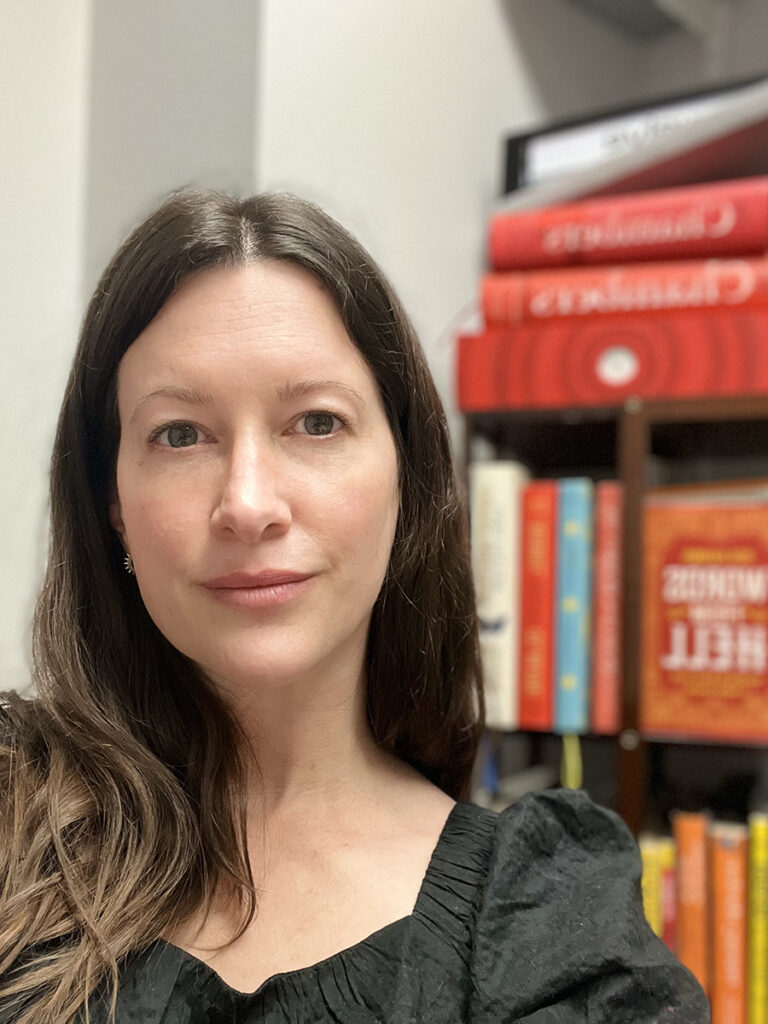
She said she chose to frame the class around sustainability because she was aware of the stigma and reluctance around AI on the part of many of her students, “and I wanted to recognize that and make sure that they’re in control of it, and that they can inform policies so that it doesn’t feel so scary.”
In the class, the students examined the legal theories around training AI models. Cole asked them to create custom Gems in Google Gemini, which they prompted to write stories in specific genres and styles, then evaluated each other’s output to compare and contrast human and AI capabilities.
They went through the entire book development process using publishing-specific AI tools, evaluating them not only for accuracy and efficiency, but also token use and carbon footprint. They used AI to design book jackets and imagined an entire publishing workflow using agentic AI. Cole focused on “sustainable prompting,” not to encourage AI use, but to minimize its impact on the environment and their own mental wellbeing.
“I said, ‘OK, this actually is a sustainability issue because if you’re not prompting effectively, you’re overusing tokens and that’s an energy drain, and so how do we control that?’” Cole said.
Partnering with Industry
Because Emerson’s publishing program is a BISG member, Cole’s students have been meeting monthly with the organization’s AI Working Group, which is studying how artificial intelligence is being used across the industry, as well as its benefits and risks. The FAQs are being developed from conversations and issues arising within that group, as well as sustainability-centric questions related to what they’re studying in class.
The students divvied up FAQs based on their particular interests, and collaborated with one another when those interests intersected with others. Moser concentrated on questions around disclosure and disclosure policies, because she feels strongly that publishers should make it clear when they are using AI at all stages throughout the process and ultimately, to the public.
Brooke Horn, BISG membership & operations manager, said she loves having the students involved with the Working Group because they’re “asking the questions that everyone’s thinking” but maybe are afraid to ask.
“I think it’s really interesting, because AI is something that everyone is trying to get their arms around largely at the same time, which is unusual in rollouts for big industry-wide changes, so it’s interesting to see that kind of leveling the playing field,” Horn said.
The students also approach the questions from a broader, more academic level than the professionals, who are maybe laser focused on their organization, department, or role, she said.
“It’s theoretical, it’s ‘How do you approach this? What are the ethical considerations of this?’ And we’ve had some really lovely discussions as a result of that,” Horn said.
BISG members also presented to the class a report based on a survey they did last summer of North American industry professionals representing 550 publishers, publishing partners, and librarians and their concerns around AI, which helped the class understand how the industry actually was and was not using the technology.
Worries about hallucinations, ethics, and copyright infringements were widespread, according to Horn. Librarians had specific concerns about content curation and AI-generated content “flooding” platforms. Canadian publishers were more concerned about environmental considerations than their American counterparts.
Watch: Sarah Cole and Brooke Horn discuss AI in Publishing: Editorial, Metadata and Reader Trust in a BISG webinar.
Using Their Voices
Cole said all of the big publishers are experimenting with AI at some point in the development process, though whether they’re actually adopting it is less clear. Her class got a demo of a platform designed by industry professionals that creates back cover copy, BISAC (Book Industry Standards and Communications) codes, and keywords from an upload of a book manuscript.
The functionality was “actually excellent,” Cole said, and the students were alarmed. They wondered if they would find entry-level jobs if a platform could do so much, so well. But there still needs to be a human to review and edit the work of even the best AI, Cole said.
Her students still have concerns about the long-term implications of AI on the industry, but Cole said some of them are starting to see the advantages of learning about these issues, because they’re seeing AI show up more and more in job descriptions. They’ve also learned that while they can’t stop the publishing world from adopting AI tools, they can have a voice in how these tools are used.
Researching and drafting FAQs for the North American publishing industry is one way.
“I want them to feel empowered to be those voices in the market and not let the tech companies make all the decisions,” Cole said. “And because they’re doing research through speaking to lots of people, I think what they’re hearing is that there’s concern in the industry, too.”
One of the final projects Cole gave her students was to create AI policies that reflect their own personal views, values, and best practices. The students then peer reviewed each other’s policies.
Moser said in her ideal world, AI would not exist. But after taking Sustainable Publishing with Artificial Intelligence and working with BISG on the FAQs, she now has articulated her beliefs and ethics around AI and the reasoning behind them – which she can share with employers and colleagues in the future.
“The class is not about learning how to publish with AI, it’s about understanding how this force is changing and reshaping the industry and learning how to cope with it,” Moser said. “It’s about critical thinking and about sustainability, and whether that means ethical considerations or environmental considerations, that we have to think about the job market and how it’s changing in response to AI.”
Categories
