
Building Your Own Major: Nel Blinman ’26 Turns Trash Into Political Puppetry
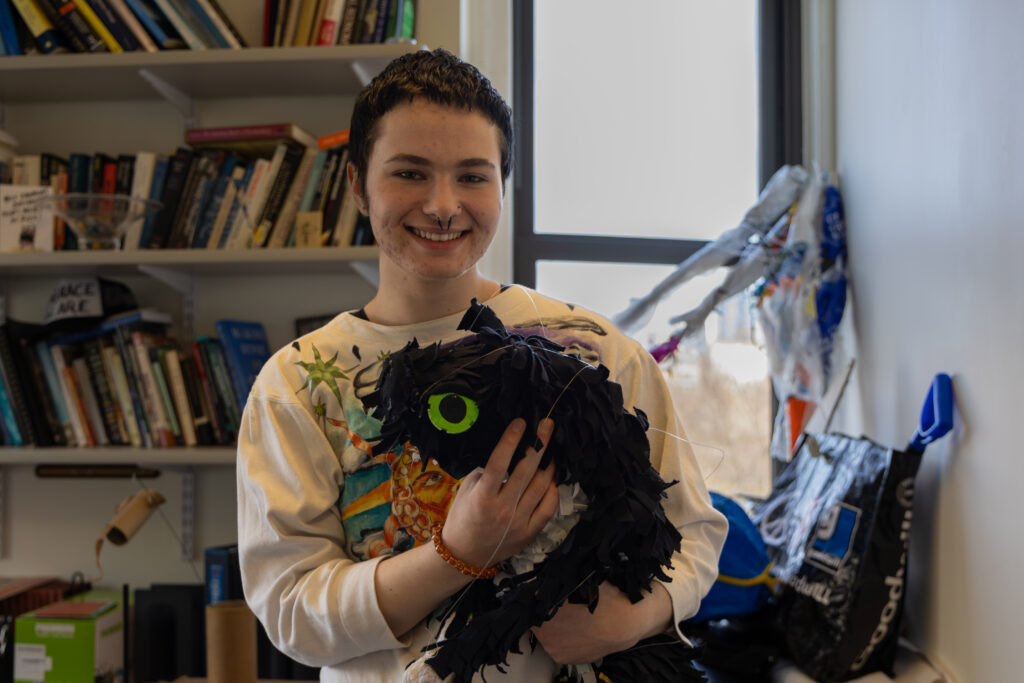
Nel Blinman ’26 wants to use puppetry to influence society. That is why Blinman created their own Interdisciplinary Studies (IDS) program major examining the intersection of anthropology and puppetry.
What is the title of your self-created Interdisciplinary Studies major?
Blinman: The official title of my major is Anthropology and Puppetry as a Subversive Art, but if people ask me I usually just say Anthropology and Puppetry.
Why did you choose Anthropology and Puppetry as a Subversive Art?
Blinman: I wanted to study puppetry and I knew I wanted to study anthropology, although really I think I should have been doing philosophy. That’s my minor, and I think I could have swapped those two. But regardless, the majority of my programming was anthropology-related, and I knew I was interested in puppetry, but not just puppetry as entertainment. I was interested in puppetry as it functions sociopolitically, the way that people have used puppetry for political, cultural, and social change throughout history.
You started at Emerson as a Theater Education major, why did you switch to IDS?
Blinman: I thought I wanted to be an actor, and when I got to Emerson I pretty quickly realized that’s not what I wanted. I was super interested in the theoretical classes that I took about theater, but not so much in the performance part of it. So I started looking into [whether there was] some kind of theater and sociology program that I could do. I got in touch with IDS to create the major.
Once I found out through IDS that I could do all these other things, and I’d started taking sociology and anthropology classes here, I realized that that was the department that I was the most interested in exploring.
What was the process of designing your major like?
Blinman: I got interested in puppetry specifically at the end of my freshman year and into my sophomore year. When I first brought it up to the IDS Curriculum Committee, they were excited but also a little nervous. There’s not an official puppetry program at Emerson, and there’s really one consistent puppetry class and it’s a graduate class. So it was a little hard to come up with my program. But what I ended up doing was taking mostly anthropology classes and working with professors who understood my programming. I took a lot of classes with the same professors. I approached all my curriculum through the lens of puppetry—a lot of classes that I chose were based on availability and timing, and also just my general interests, and then I applied puppetry as the lens for those classes. So a lot of my papers have been about puppetry within the confines of what I was learning about in that class.
How do you want to use your major in your career and life after graduation?
Blinman: I’ve applied to some library and information science programs for my masters. I’m really interested in doing archival management work, specifically related to puppetry. There are archives of puppets in the United States and elsewhere and there’s not a lot of people doing work specifically in that field. I’m also really interested in writing and doing research on puppetry within the field of anthropology. There’s a few scholars who are working on that, but there’s not that many, so I’d like to pursue this same academic world to a higher level someday, but I’m going to start with librarianship.
How has Emerson provided support for you throughout this process?
Blinman: They’ve been really fantastic in a lot of ways. I’ve had some amazing professors. Allowing me to be flexible with the classes and allowing me to do work outside of school has been very helpful. I’ve done internships as a replacement for proper training to get a more well-rounded education. They’ve given me resources to be able to put on a puppet show for my capstone, and I’ve got some funding for that—which is awesome. It’s been a really great exchange with my professors [who teach anthropology], the ArtsEmerson staff, and the Theatre Department, all working together to really connect me not only within Emerson, but also to organizations outside of Emerson.
What extracurriculars and classes stood out to you?
Blinman: Just last semester I took Beyond Human with [Center for Comedic Arts Affiliated Faculty] Jodie Egerton, which was very fun. That class was great. I took Collective Action with [Marlboro Institute Associate Professor] Mneesha Gellman a couple years ago, and that class was fantastic for learning about research writing and being able to look at how puppetry functions politically. She was great in supporting me in that even though it’s not her field of study. I’m in the Honors program, and my thesis, which I finished last semester, was about puppetry and I had some really great support for that as well. Sometimes I come into conversations in classes and I don’t know that people will get it, but everybody’s been really awesome.
Could you please talk more about what kinds of classes were required in your major?
Blinman: The way that the IDS major works is you generally pull from different majors at Emerson, but my programming is not within any particular majors. So where a lot of IDS majors have to take certain prerequisite classes, I didn’t have to do the same kinds of prerequisite work and got some flexibility in taking what I wanted to take. I wormed my way into the graduate level puppetry class when I was a sophomore. The requirements change based on what classes are available, but my major plan is the official document that structures my major and I can update that with approval from my advisor and the IDS Curriculum Committee. They review the classes that I submit, so it’s a collaborative process.
What was the process like for your capstone?
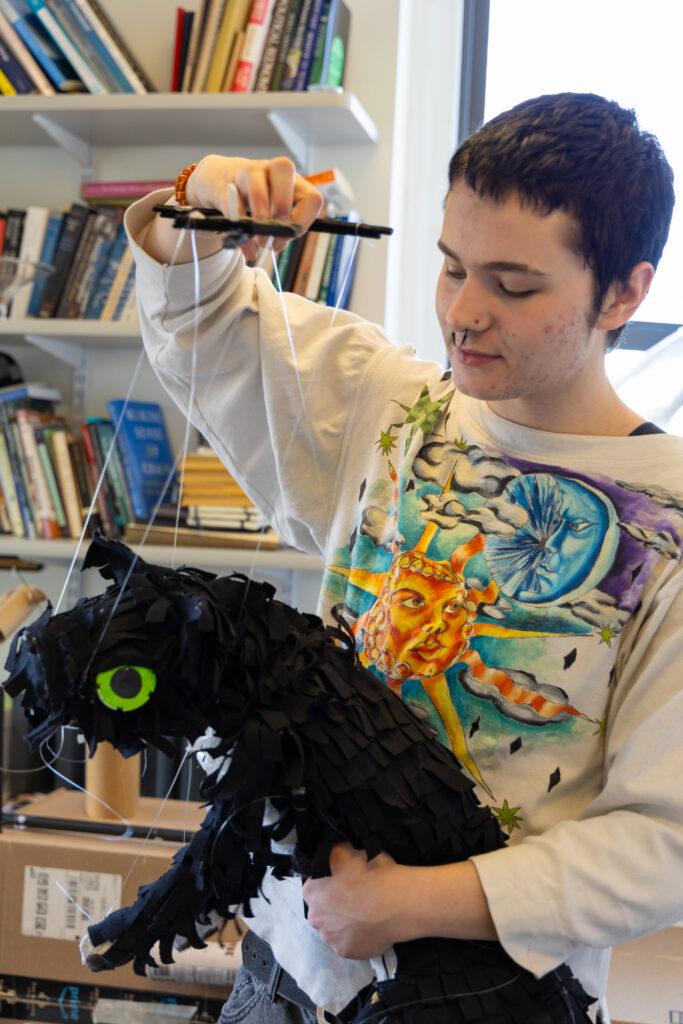
Blinman: The capstone generally has an analytical component and a creative component. Because I’m an honors student, my thesis was allowed to function as my analytical component which was awesome. I wrote about puppetry and environmentalism specifically about trash and waste and the way that puppetry can change how we think about trash. This semester I’ve been working on my creative component, which is a puppet show called Kitty Litter that’s going up at the end of this month. It’s been a lot of work! But it’s something I’ve really wanted to do. The show is about a cat who gets stuck in an extinction event level storm and befriends a pile of trash. I made all the puppets out of trash—my house is full of trash right now, which I’m sure my roommates are very happy with me about. I’ve been working with an awesome cast, and I’m also in the show and directing the show, which is a lot of hats to wear but I want to be evaluated not only on my creation of the puppets but also my performance of them. Planning it and getting it done is one thing, and then after it’s done I have to give some reflection and put together a compilation of evidence for the IDS Curriculum Committee so that it can be reviewed as an official assignment.
Is there anything else you’d like to share about yourself, your major, or your Emerson experience?
Blinman: I’ll just say that the Marlboro Institute is probably my favorite thing about Emerson College. It’s fantastic that they were able to keep the legacy of Marlboro College alive because I think it’s a great community, and having some of those original Marlboro professors has been awesome. They’ve been some of the best teachers I’ve ever had. I always encourage everybody to take a Marlboro Institute class, even if they’re not in the Institute.
Categories
