
Emerson’s New SOA Dean on Interdisciplinarity, AI, and Shakespeare
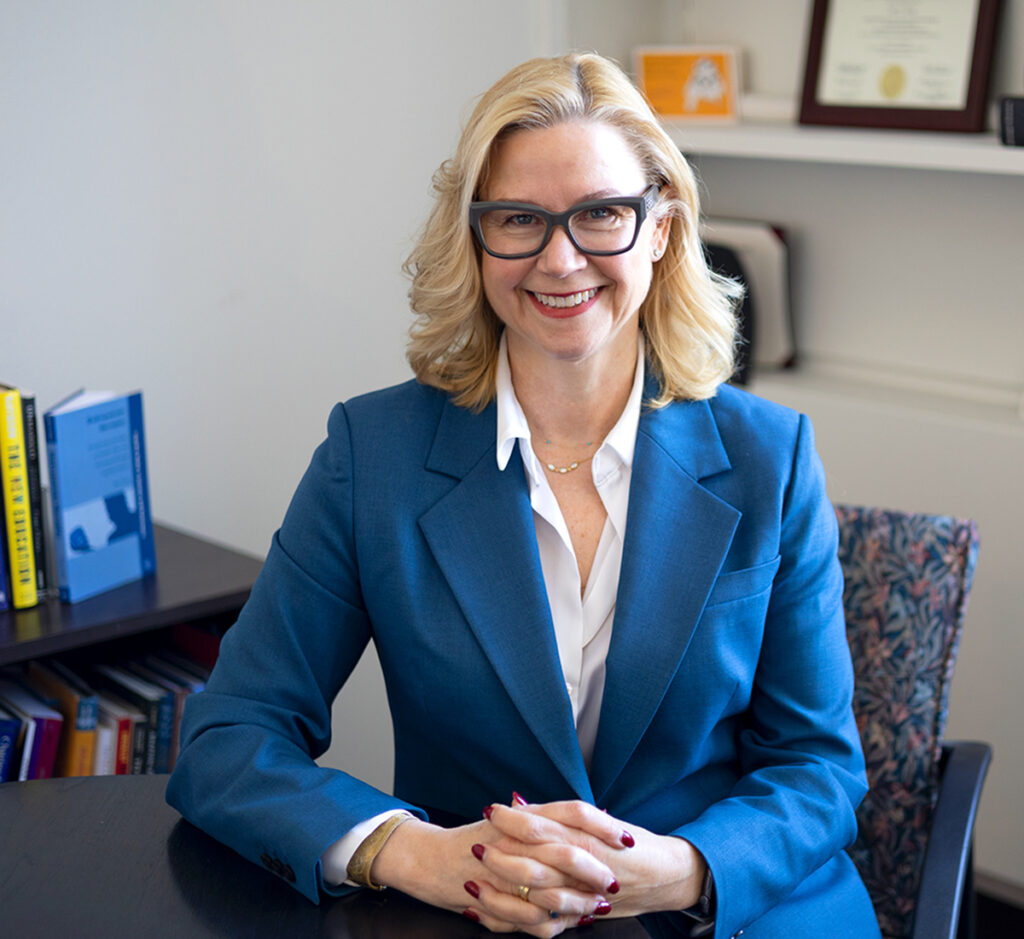
Dr. Amy Cook will become Emerson’s new Dean of the School of Arts and Interdisciplinary Studies on July 1, 2026.
She joins Emerson from Stony Brook University, where she served as Vice Provost of Academic Affairs, Associate Dean of Research and Innovation, Chair of the Department of Art, and Professor of English. In these roles, she found creative solutions to complex challenges, built programs to improve access and inclusion, and advocated for the arts and intellectual curiosity across Stony Brook.
Emerson Today asked Dr. Cook about what drew her to Emerson, how the arts and liberal arts fit into a rapidly changing economy, and why everyone should have a Shakespeare line or two at the ready.
What drew you to Emerson? What excites you about the college?
Emerson is perfectly poised to take advantage of a very challenging moment in higher education. As a world-leader in arts and communications, with incredible campuses in Boston, LA, and Kasteel Well, and a proud and devoted alumni, Emerson can be the leader in what comes next.
I am passionate about the potential for artists, communicators, and interdisciplinary scholars to transform the challenging present into the extraordinary future. I could see all of this before I stepped on campus, but when I arrived and met some of the faculty, students, and staff that make Emerson what it is, I knew that Emerson had what it takes. What excites me the most is the infinite potential of the people at Emerson.
What strengths and opportunities do you see within the School of the Arts?
When I heard about the makeup of the School of the Arts and Interdisciplinary Studies, I thought someone had created an ideal home for me.
The storytellers that come to Emerson will shape how we imagine what’s new, what’s possible. I am excited about the potential of a bridge between Interdisciplinary Studies and the arts, as creating can activate learning, and without ceaseless curiosity and learning, storytellers can lose touch with what’s worth reimagining.
The School’s makeup is unique, and I see opportunities for growth because of this differentiation. I don’t know any other college with a Comedic Arts program, for example. I look forward to working with the faculty, staff, and students to think about innovative degree programs that align students with the careers and opportunities for their tomorrows.
Your work is very interdisciplinary, applying research in cognitive sciences to theater and performance criticism. Now as dean, what do you see as the role of interdisciplinary scholarship and collaboration at Emerson?
Interdisciplinarity for me is about seeing the relationship between two areas, listening across differences, and valuing and growing from these connections. I’ve always believed that the big questions do not respect disciplinary boundaries, and progress requires thinking outside our departments; my role now as dean is to help create a place where there’s the listening across difference necessary to see the way forward. Collaboration is going to be necessary to face and overcome the challenges we are facing, as a college and as a country.
You led the charge in creating guidance for ethical AI use at Stony Brook. What did you learn from that experience?
Well, I quickly learned that “leading” wasn’t going to work nearly as well as collaborating! This is an area where technology is moving faster than “the speed of trust,” to paraphrase both Stephen Covey and adrienne maree brown. It is necessary to create more spaces where more people are talking and sharing about the impact of GenAI and teaching and learning.
There are very different perspectives on campuses and there is room for this diversity! What the committee of faculty, staff, and students created was a document about our values – about transparency, critical thinking, the centrality of the human, and the need to serve the students we have for the world we are living in. I do not believe we can stop GenAI, and I worry about pretending that we can. I want us to think critically about assessment: Some of our old ways of measuring learning are going to have to change.
How does an education in the arts and liberal arts prepare students for a 21st-century workforce?
I might push back on the question a bit. First, I don’t think that the 21st century is going to have a “workforce” in the same way that the 20th century did. Second, Emerson students seem like the kinds of people who are going to create the future, not be cogs in it.
There’s an outdated assumption that arts and liberal arts aren’t career-focused and the evidence simply does not support that. What employers need – especially given AI – is what arts and liberal arts education has always produced: people who can think across boundaries, communicate with precision and humanity, make meaning out of complexity, and bring judgment to situations where there’s no algorithm to follow.
I think that the arts will be what engineering and computer science has been for the past 50 years. The arts and liberal arts prioritizes the collaborative project that requires and hones the skills we all need: project management, storytelling, revising and iterating based on feedback, taking different perspectives, and meeting deadlines.
As a Shakespeare scholar, which of his plays would you require every human to read and why?
I wouldn’t require anyone to read a Shakespeare play – I might insist they see a production, though. Shakespeare needs actors and directors and designers and scholars to bring the poetry to life. I might invite them to read – out loud – Touchstone’s lecture on the power of “If” at the end of As You Like It, or pull up Kenneth Branagh’s version of the “band of brothers” speech from Henry V on YouTube.
I can center myself while running an errand by repeating the “to be or not to be” soliloquy. I would want everyone to have a line or two that they can roll around their mouths when times are great and when times are hard because of the pleasure it brings and how it can remind us of who we can be. I can extoll the wisdom in the plays all day, but it is the work that they do – or sections of the poetry can do – when they are brought to life by humans passionately telling an old story for a new audience that is important to me, to us.
Categories
