
Building Your Own Major: Helmhold ’27 Connects Sports and Psychology Through Communication
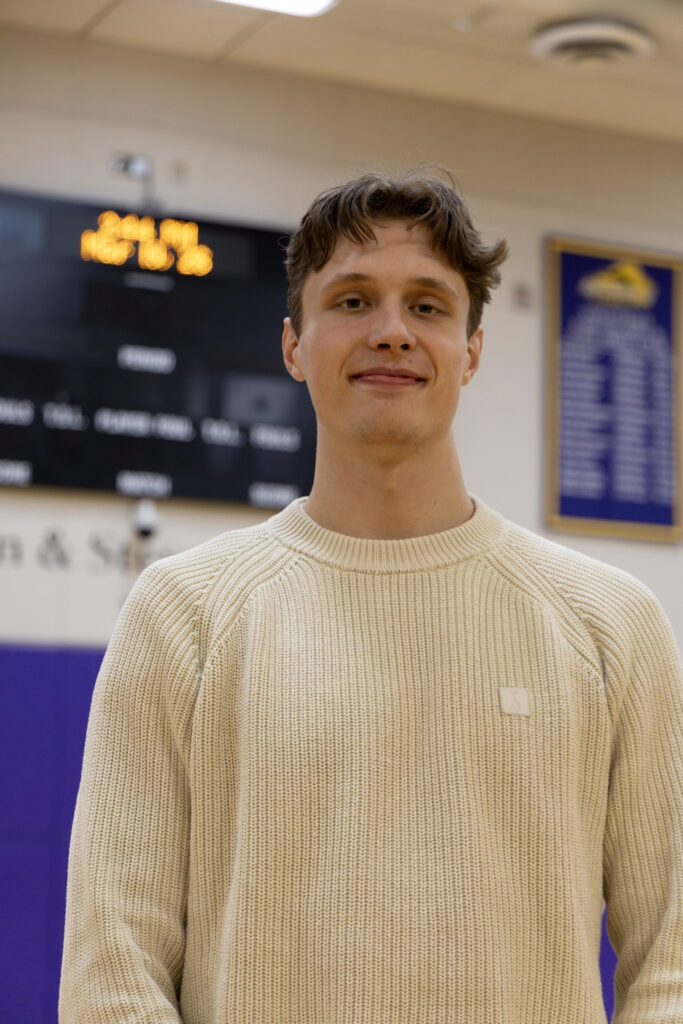
Linus Helmhold ’26 didn’t just choose a major—he built one. After transferring to Emerson College, he combined his interests in sports and psychology to create an Interdisciplinary Studies major focused on communication strategies in athletics.
Why did you choose Sports and Communication Strategies in Athletics?
Helmhold: I knew I wanted to study psychology. And I thought that the Communication Studies department at Emerson was special and unique, and combining it with my interest in sports just made sense.
What was the process like to create your own IDS major?
Helmhold: It kind of took shape as the semesters went on, especially because coming into Emerson I didn’t know a lot about what IDS entailed. I had to learn all the terminology and components as I went, but designing my major happened naturally as I went. I’d hear about classes here and there and it molded into this really awesome thing that it is now. It allowed me to be very autonomous in my decisions around what classes I wanted to take and what areas I wanted to look more into.
What is the goal behind this field of study, and how do you envision using it in your life after graduation?
Helmhold: I’m going to grad school next year for counseling. I got accepted into NYU, Northeastern, and the University of Miami. I think this major definitely set me apart because it allowed me to specify the courses that I think will help me in the future. I want to be a sports psychologist, that’s my main career aspiration. Other than that, this major gives you the opportunity to get some practical experience in the field that you’re interested in. For me, that’s kind of ironic because practical experience means theoretical papers, but it still allows me to engage with sports psychology in a way that’s really helpful.
How has Emerson provided support for you, whether that’s academically, personally, or professionally?
Helmhold: I think the great thing about the major that I’m in is that you have a very small group of professors and peers and supporters, which makes it very personal, and everyone really cares about you. In my time as an IDS major, I had my two professors, [IDS Director of Communications & Operations] Adam [Greenfield] and [Communication Sciences & Disorders Assistant Director] Kellie [Savard], who were very helpful in helping me formulate ideas or see things from a different perspective. So from a structural standpoint those two were very valuable.
And I’ve worked with my advisor [Marketing Communication Assistant Professor Cameron] Bunker and my reader [IDS Professor & Director of Faculty Development] Lindsey Beck for the past two years. Because it’s such a small major, I feel very cared for in my academic environment, which is rare in a lot of schools.
What classes have you taken for your major? What have been some of your favorite classes?
Helmhold: I took a Media Psychology class, which was definitely one of my favorite classes I’ve taken at Emerson. I think social media has become one of the cornerstones of my capstone; my first paper revolves around how social media affects athletes’ mental health, and I developed a lot of my theories and ideas in that class. That’s how I got to know Dr. Bunker better and ask him to be my advisor, so that was a pivotal moment in my time at Emerson. Another interesting class was Psychology of Relationships with Dr. Beck. We talked about a lot of different interrelationships, relationship styles, how they impact people, and I really enjoyed that. And then lastly I’d say my junior and senior seminars with my IDS classmates, because in that class we do a lot of peer feedback and discussion, and I think it’s fascinating what other people have come up with. My major is probably on the more straightforward side; I haven’t reinvented the wheel here, but some of my classmates have really done some super unique and interesting things, so I like going into that room where you know you’re going to learn something new.
Every IDS major must have a capstone project. What is your capstone project?
Helmhold: So with Sports Psychology I’m looking at online and offline relationships. Those are different categories with different components that satisfy the information required. My first component is social media, and how it impacts athletes’ mental health. I’m looking at it through a lens of something called self-determination theory, which basically tries to answer the question of what humans need to be motivated and fulfilled in their lives. I used that to create interview questions and then interviewed a bunch of different NBA and NCAA and NFL sports psychologists, and got their stance on a bunch of different things. That was interesting from a networking perspective as well, and I had a lot of fun talking to these high-level people in my field.
The second component, which I’m conducting right now, looks at a communication theory called transactional analysis. Basically, there’s these two different egos, and you communicate between them in your day-to-day life, and I’m using that to answer the question of how coaches and athletes could communicate better. I’m doing a workshop with coaches in a few weeks to inform them about all this, which I think will be really cool. So that’s what my major is going to come out to at the end of the day. You have a lot of choice over your education, which is very freeing. Usually in school you pick a major and are told what to do from there, but IDS isn’t like that, so you have to just trust the process.
Any final thoughts?
Helmhold: I truly believe that this is a great major and a great opportunity for everyone. You learn a lot of discipline and creativity, as well as trust in yourself and the institution. It’s an ever-changing process throughout your time here, but I think if you work hard it allows you to do so much more than a regular major would. I managed to complete my goal of going to grad school next year, so I’m happy.
Categories
