
Emerson CSD Leads the Conversation at the 2026 Meeting on Language in Autism
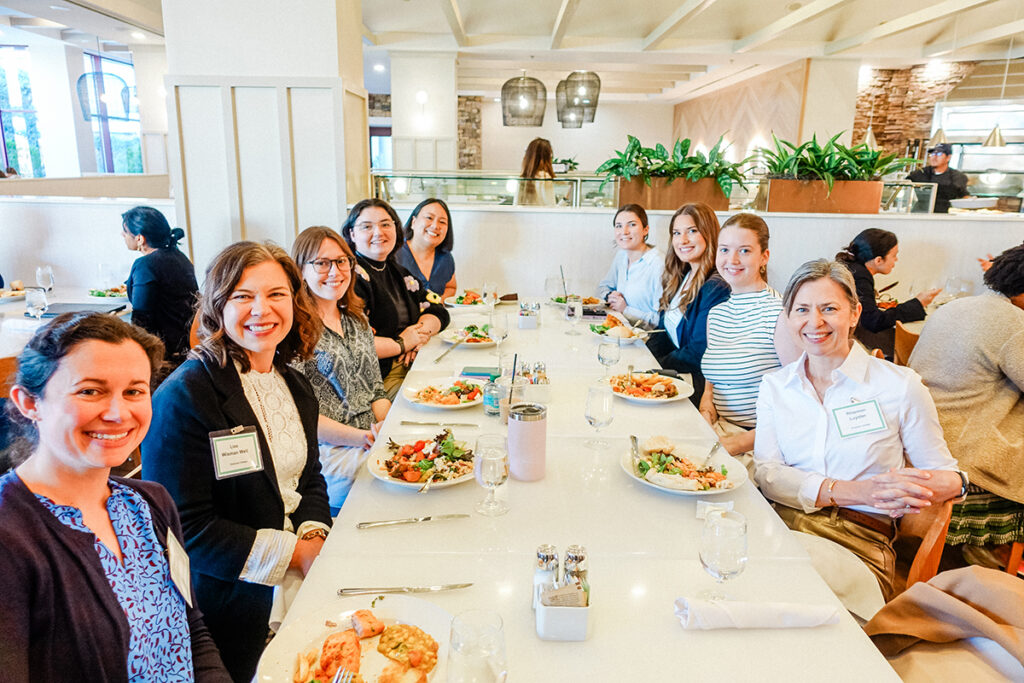
Twelve Emerson faculty, staff, and graduate students in the Department of Communication Sciences and Disorders joined nearly 200 other professionals at the third biennial Meeting on Language in Autism (MoLA) at Emory University from March 11-14.
MoLA’s goal is to bring together researchers studying questions of language in autism from a variety of backgrounds, topics, and approaches.
The conference was co-organized by Professor Rhiannon Luyster, director of the Lab for Infant + Toddler Language (LI+TLE Lab), with faculty from Emory, Duke, Miami University, University of Connecticut, and University of Michigan. It featured a podium presentation by Professor and Facial Affective and Communicative Expressions (FACE) Lab Director Ruth Grossman and research coordinator Elana Groves, a moderated panel by Luyster, and five graduate students presenting posters.
Attendees also heard from speakers from UCLA and University of Texas, saw more than 110 posters, and socialized with scientists and students who flew in from around the world, including from South Korea and the Netherlands.
Spotlight on Student/Staff Research
Emerson’s students and staff presented their previous work on autism and language in the FACE and LI+TLE labs, including findings on a wide array of critical topics, ranging from early childhood development to the nuances of adult identity.
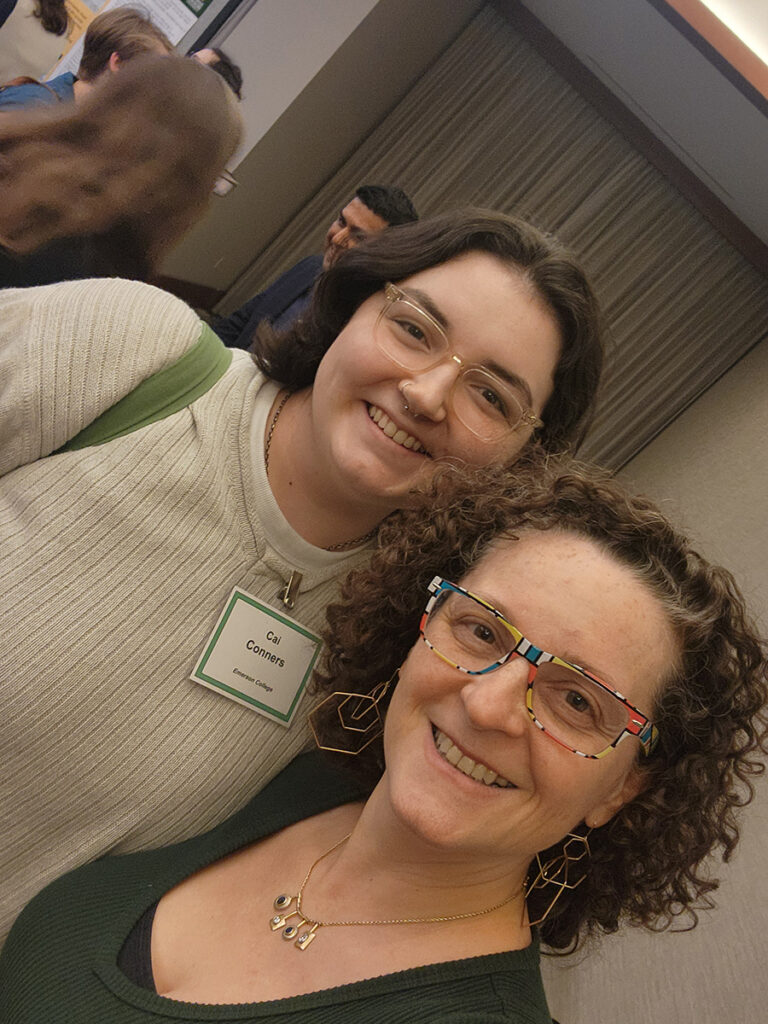
Cai Conners ’23, MS ’25 (working with Grossman), presented a poster, “Use of group affiliation language by cisgender and gender-expansive autistic adults: a mixed methods analysis,” which explored the different ways autistic cis-gender and autistic gender expansive autistic adult use strong vs qualified affiliation language when talking about community and belonging.
Grace Flanagan, a second-year graduate student (working with Luyster), presented “Who makes the cut? Children with less language have higher rates of track loss in gaze tracking tasks,” which analyzes whether autistic children who have more difficulty speaking tend to have more missing or unusable data in eye-tracking studies.
First-year graduate student Lerato Mensah-Aborampah (working with Luyster) presented a poster, “Parents’ perceptions of the role of screen media in their autistic child’s development of play and language,” which addresses the value of screen time for learning, and whether parents of autistic children have different perceptions of the value of screen media, using a nationwide remote study of over 200 participants.
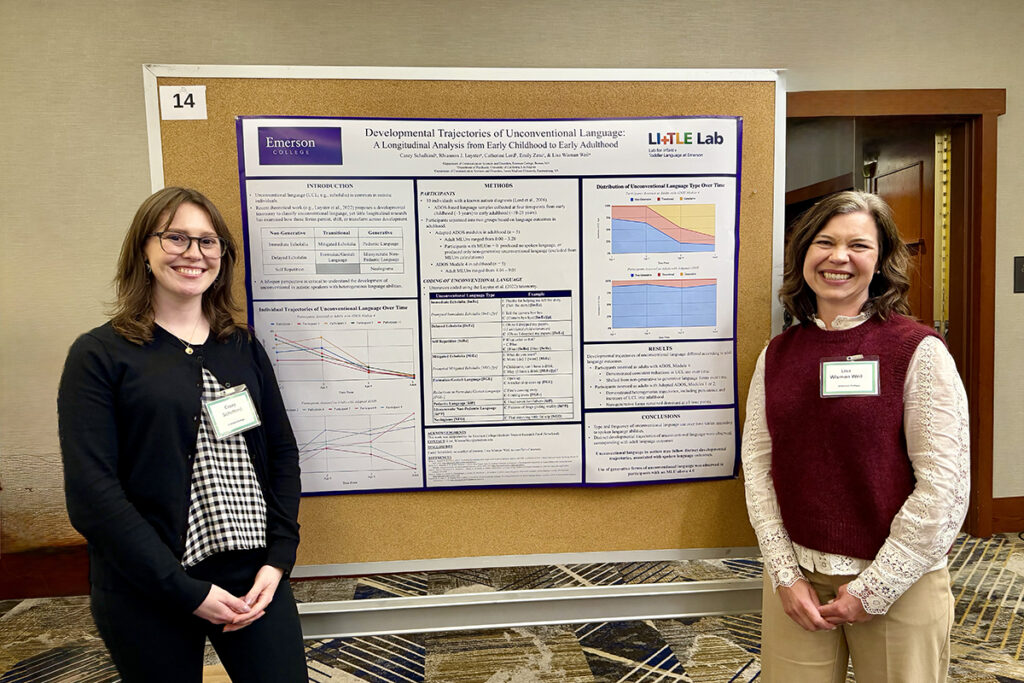
Casey Schulkind, a second-year graduate student (working with Assistant Professor Lisa Wisman Weil), presented a poster “Developmental Trajectories of Unconventional Language: A Longitudinal Analysis from Early Childhood to Early Adulthood” which analyzed language samples collected from autistic children at four timepoints from early childhood to early adulthood, and analyzed patterns of unconventional language over time. Shulkind was the recipient of a 2026 Plural Publishing Research Award Scholarship for her research.
Second-year graduate student Gabriela Spizale (working with Luyster), presented her poster, “The Favorite Interests of Autistic Preschoolers with Varying Levels of Expressive Language,” which used data from 60 preschoolers with autism spectrum disorder to analyze the focused interests of children with different levels of spoken language.
Spizale said presenting at the conference pushed her to think about their research in a more “applied and accessible way.”
“Explaining our findings to a broader audience helped me better understand the clinical relevance of children’s interests. It also gave me new perspectives from other researchers, which made me think more critically. I would encourage students to be proactive and reach out to faculty whose work aligns with their interests! Even if you don’t have prior research experience, showing curiosity and willingness to learn goes a long way,” Spizale said.
Article by Office of Research and Creative Scholarship (ORCS) Senior Associate Director for Grants and Proposals Diana Potter and Leah Shosteck, MA’26.
Categories
