Natalie Lemle, MFA ’24 on the Dark Side of the Art World and Writing ‘Artifacts’

Natalie Lemle, MFA ’24 already had a draft of her debut novel before she started Emerson’s MFA in Creative Writing program, but once here, she said faculty and fellow students helped her turn it into a book that Simon & Schuster bought in a pre-empt in late 2023.
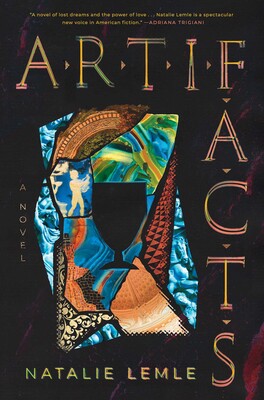
Artifacts, a page-turner about the world of stolen art and antiquities, follows an attorney who must cast back to her college days working on an archeological dig to determine what roles she may have played in the looting of the site and the disappearance of her professor. The story was informed by Lemle’s career as an art advisor and founder of art_works, which connects collectors and artists from bases in Boston and Montreal, as well as her background as a classics and art history major at Tufts University, where she had the opportunity to go on a dig in Italy.
The novel, which was published in May, earned rave reviews from Art in America, Town & Country, and Forbes. Emerson Today talked to Lemle after the novel was purchased. The conversation has been edited for length and clarity.
ET: Your novel is set in the world of stolen art and antiquities, and you come from the art world, although a very different corner of it. Could you tell me a little bit about your day job as an art advisor and your work with artwork?
NL: In my day job, I work with living artists and mostly with contemporary art, although my academic background is in ancient art — I studied classics and art history. I see a ton of parallels between, at least when it comes to the market, ancient art and contemporary art.
I’m working with a lot of corporate collectors — companies that are collecting art — and then individuals [who] are collecting art. And my work is mostly around the idea that art does not have to exist for its own sake, that you can support artists by collecting their work. I am really interested in the idea of social return on investment, of art being more than just an object. And what does art represent, what does it mean? But just in a nutshell, I am helping companies and individuals collect art or manage their collections.
Before [I built my company] I worked in other avenues of the art world. I worked at a gallery, I worked at the Museum of Fine Arts, I’ve done lots of different things. But working with living artists, you really get to feel more connected to the actual art. And artists would always say, ‘So you must be an artist, what do you make? Do you paint?’ And it’s like, no, I’m a writer. That’s my creative outlet. Now, it’s more than an outlet, but that, to me, has always been my art. And when it comes to visual art, I’ve always loved writing about it, and that’s why I studied art history.
ET: When you were writing this novel, you kind of went to the dark side a little bit. What was the impetus there?
NL: In the novel, one of the plotlines follows a contemporary work of art that has been donated by a collector. My main character, Lena, she’s a trust and estates attorney, so she helps people with their estates, and sometimes they’re donating art as part of that, so in her job, she’s kind of on the fringes. She’s very much on the money side of things. She’s looking at like, ‘Oh, if this painting is worth $10 million, then you can expense 35 percent of that against your income, and now it’s tax deductible.’ She’s looking for those tax loopholes, which I am really fascinated by. When I worked at the Museum of Fine Arts, I sat next to the director of planned giving, and I was really, really fascinated by [people’s] motivations for donating art to an institution. I see it now a lot in my world working with contemporary art. A collector will have something, they’ll buy something and they’ll live with it, but their intent is to donate it to an institution and to eventually get that tax write-off.
[And then] there’s this famous curator from the Getty, Marion True, she was being prosecuted by the country of Italy and the country of Greece for furthering the market in looted antiquities, and she sort of became the scapegoat for what all American museums were doing. And I was just so fascinated by that, just that idea that one person could sort of take the fall for what all these other institutions are doing.
I just think art, whether it’s contemporary art or whether it’s ancient art, it’s always more than just an object…. There are so many stories housed in it, and the idea that we all want to tell the story of this object, and we want to have it on display. A curator could have good intentions, but could actually be committing serious crimes that have ripple effects throughout the country of origin. That [Marion True] example is Italy and Greece, but there’s tons of looted antiquities from war-torn countries like Syria and North Africa.
And there is an element of organized crime in the book, too, really getting into how exactly these objects are being trafficked, why they are being trafficked, trying to understand why is this happening. It’s a really interesting, ridiculous, crazy world under the surface.
ET: I’ve always wondered, how do you fence stolen art? Everybody knows what it is. Everyone knows what it looks like. Everyone knows it’s stolen, once it’s stolen.
NL: I know, a lot of it is collateral. The book also… goes back and forth between 2004 and 2022, so there’s the present plotline and what Lena is discovering, but a lot has changed in those 18 years between 2004 and 2022 in terms of the law, in terms of what curators will look at, what they won’t look at.
And I think even in the past two years, people have been put in jail, things have been repatriated. There’s tons of stuff happening with the Benin bronzes in Nigeria, that was all kind of breaking news, so it’s really rapidly evolving, and when you look back, to your point, it’s like you think, ‘Why would somebody buy something stolen?’ But in 2004, people were really doing it.
ET: Can you talk about your writing journey and how you came to Emerson to pursue an MFA?
NL: It was always just my creative outlet. I have two little kids now, but before I had kids, I would wake up before work and be writing and always working on something, but always just feeling like I’m an amateur, this is just something that I do for fun. Then of course, …I’m always writing, even for business and telling the story about the artists that I’m working with, writing wall labels and all of that stuff.
But it was in the pandemic, just feeling like all of us having that identity crisis of ‘What am I really doing all of this for, who’s benefiting from this work?’ And I just started writing more and taking my writing more seriously. I applied to MFA programs mostly to hold myself accountable to continuing to write, because it’s this part of myself that I wanted to continue to invest my time in. I don’t think I could have done a traditional MFA because I also work, I have my company, and Emerson [made] it possible for me to do this. It felt serendipitous that this is a program that is rigorous but also flexible, that I could continue to do the other things I was doing.
I had written a draft of [the novel] actually before I started the MFA, and I submitted it to … a manuscript editing class, basically. I do not think the book would’ve sold if I hadn’t been able to get feedback on the whole manuscript, which is another thing that’s really unique to Emerson. I’ve never heard of that kind of crossover in other MFA programs where you actually get to gain the benefit of everybody else’s knowledge [who’s] in the program. … It was brutal feedback, but it made the manuscript way better.
ET: When you were working on this, who were your advisors at Emerson and how did they help shape what you ended up submitting to?
NL: My thesis advisor [was] [Senior Lecturer] Steve Himmer, but the thing is, along the way — this is such a cool Emerson story because in fact, the people that helped ‘shape’ the manuscript [were] a lot of students in the Publishing program, because it was workshopped in two of those publishing courses. So as far as the shape of it, credit goes to them.
But Steve Himmer, [former Assistant Professor] Novuyo [Tshuma], and [Professor Emeritus] Steve Yarbrough and [Professor] Rick Reiken, all of them, I was confiding in them all along the way when I was trying to get an agent. And then when I got the agent, I revised it with my agent too, and that was a totally nerve-wracking process because of course, she’s a super smart and thoughtful reader, but also, she’s giving me notes with an eye towards selling it.
It’s just such an emotional roller coaster, and it would’ve been way worse if I didn’t have this community to confide in. They’re just so supportive when I got the agent, when the book sold, just all the words of encouragement and feeling like they were invested in part of it. And Steve Himmer — this is not my thesis, but he took the time to read the whole manuscript, and I am so thankful to be a part of this community.
ET: Is there anything you can tell us about your next project?
NL: It’s another art world-based novel, but not ancient art, more living artists. And definitely drawing from, I won’t say necessarily my own experience, but just from my work in the art world.
I think it comes from wanting to read more about art. I mean, there are so many historical fiction novels about [works of art]: Girl with a Pearl Earring, The Unicorn, The Marriage Portrait. But I feel like if there’s ever a novel written about the contemporary art world, I’m all over it. I’m always surprised that there’s not more TV shows and films about various dysfunctional, ridiculous things in the art world.
Categories
