
Creativity@Emerson Constructing a ‘Common Language’ Across Disciplines
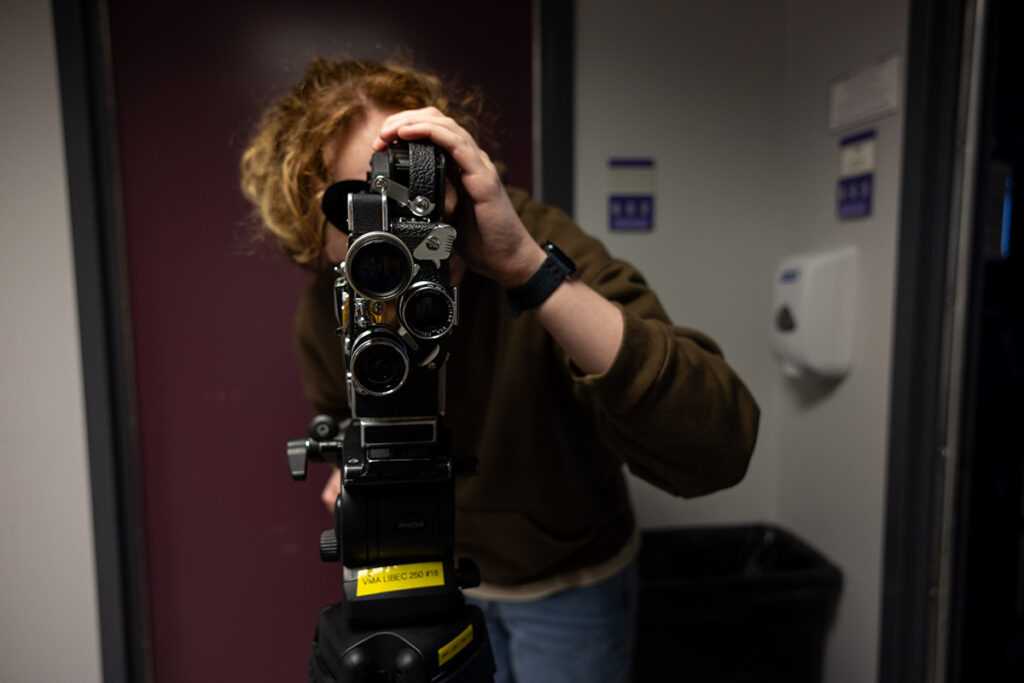
When Patti Nelson arrived at Emerson in 2019, she ran into a challenge.
The Communication Sciences & Disorders (CSD) Senior Scholar-in-Residence and Undergraduate Curriculum Coordinator knew the curricular importance of providing her speech-language pathology students interprofessional educational (IPE) opportunities, where they could learn directly from students, faculty, and clinicians in other healthcare disciplines. Faculty expect it will soon become a requirement for CSD programs.
Most CSD programs live within larger universities and can provide those IPE experiences in-house, but Emerson, as an institution for communication and the arts, was a unique case. “Although Emerson is rich in many areas, we don’t have allied health professions,” Nelson said.
She reached out to colleagues at other universities with programs that complement CSD’s training, and created a slate of IPE opportunities throughout the academic year, requiring students to attend at least one in order to graduate. Today, faculty and students from Simmons University’s social work program; from Quinnipiac’s occupational and physical therapy and nursing programs, even speech-language pathologists (SLPs) from Kenyatta University in Kenya, gather with Emerson students and faculty for online CSD learning experiences that draw as many as 200 participants.
In order to resolve CSD’s challenge, Nelson drew upon her creativity, a word that rarely gets mentioned in the same breath as “speech-language pathology,” but describes a practice that’s as integral to how SLPs treat clients as it is to how filmmakers shoot a scene or poets craft an image.
Today, Emerson Marketing Communication Professor Thomas Vogel, an international expert in the field of creativity, is hoping to establish a common language around creativity at Emerson so that students and faculty can articulate what it means and how it runs through every discipline.
“We see creativity as that connective tissue between the different courses that the students are taking,” said Vogel, who is leading the Creativity@Emerson initiative along with Marketing Communication Assistant Professor, Graduate Program Director, and Special Advisor to the Dean of the School of Communication, Carol Ferrara.
What Is Creativity?
Emerson has long been linked with creativity, as the place where students come to be trained in theatre, film, writing, marketing, and comedy.
“There is a very strong association with creativity and the ‘artsy’ stuff …. but that’s not the only thing that allows creativity to flourish and to take place,” said Vogel, author of Breakthrough Thinking: A Guide to Creative Thinking and Idea Generation and the forthcoming Creativity in the Age of AI, due out in spring 2026.
Researchers describe creativity as a “dynamic distributed process” that transcends the individual mind, he said. It’s not just a “gift” encoded in our genes or a flash of inspiration.
“It emerges from the constant interplay between a person, their body, the community, and the tools they’re surrounded with,” Vogel said. It’s deployed when we decide what to wear in the morning or what to cook for dinner, it’s there when we solve a problem at work, and sure, once in a while it can lead to works of true artistic genius.
“It’s a skill, and we can train for it. We have to train for it … because it’s so complex,” Vogel said.
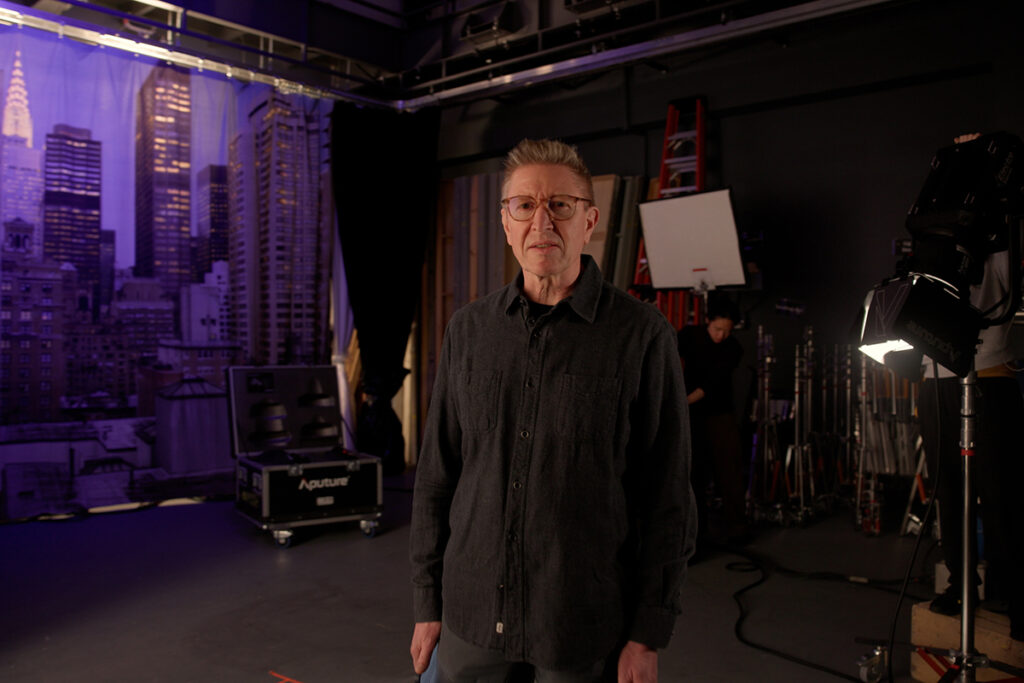
To illustrate creativity in action, Creativity@Emerson screened Radical Creatives, a film produced by Aalto University in Finland, which has engineered their entire mission, vision, and strategy around the concept of creativity and interdisciplinarity. The screening took place on November 19 in the Semel Theater, followed by a panel discussion.
Vogel’s hope for Creativity@Emerson is to eventually create a 100-level Foundations course that introduces the scaffolding of creative thinking early in a student’s academic journey, alongside the written and oral communication courses they must take. He also dreams of introducing a Creativity minor, and making Emerson a flagship institution for the teaching and study of creativity.
CSD Professor and developmental psychologist Rhiannon Luyster is one of several faculty members working with Vogel and Ferrara to lay the groundwork of Creativity@Emerson, so that students can see creativity as part of everything they do, and faculty can more clearly delineate the creativity skills they’re already teaching in most of their classes and practicing in their professional work.
Luyster has a list of several ways CSD faculty and clinicians put creativity to use to help clients, teach students, and advance their field: among them, Patti Nelson’s IPE opportunities; a course that teaches qualitative research using student-designed art experiences; a collaboration with Community Boating in Boston that aims to help people with aphasia communicate and instruct students in giving activity-specific support. Also on the list are research partnerships with students, as well as various creative classroom activities aimed at preparing students to face each new challenge that they may face in their careers as clinical providers.
As part of the Emerson department that most closely resembles a “hard science,” Luyster said she would love to see the College build a narrative that defines CSD students – like all Emerson students – as creatives.
“Because to me, creativity is really about critical thinking. It’s about knowing what you’re seeing and how to rise to that situation,” she said.
Future-Proofing Students
Paul Turano, an Associate Professor in the School of Film, Television and Media Arts, has always talked about the creative process in his classes. But since becoming involved with Creativity@Emerson, he’s started to introduce his students to concepts and practices around creative thinking and the link between movement and learning. He talks about walking as a creative act that stimulates the brain to make connections it can’t make while sitting still.
Learning to use a new tool or use a familiar tool in a new way can also get synapses firing.
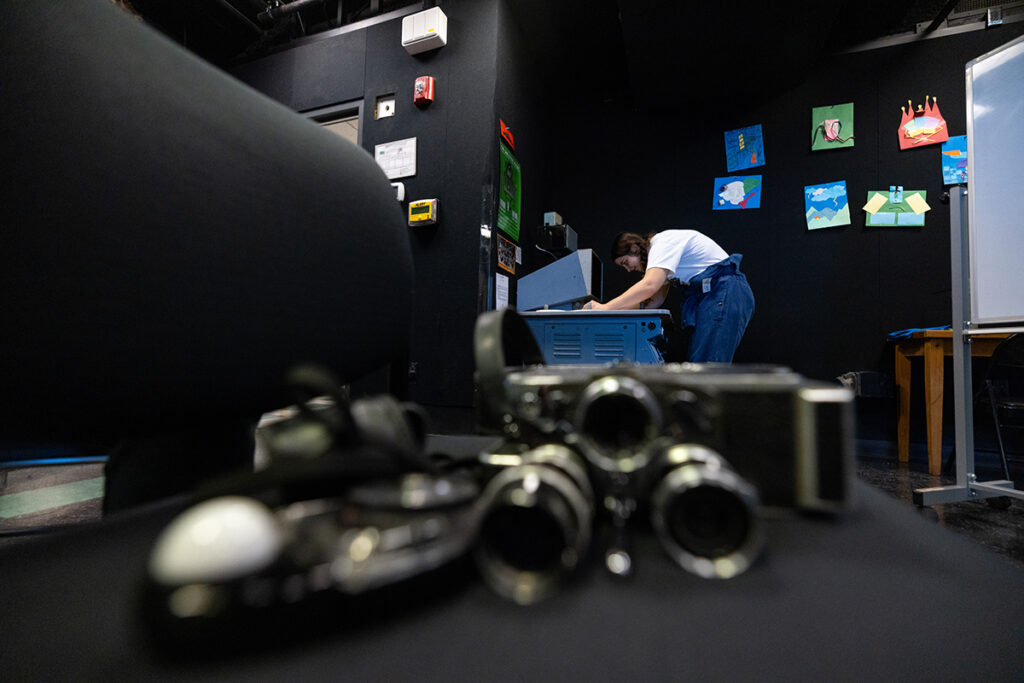
In his Intro to Film Production class, his digital-native students experiment with analog film equipment, which challenges them both mentally and physically.
“And in that discomfort, [I say] ‘Let’s talk about how you’re learning, let’s talk about what you can do with this, let’s think about the creative potential of this – knowing the limitations – to be more thoughtful about your choices,’” he said.
Turano sees that his students now are learning and synthesizing creativity in a deeper way, and see themselves not just as people who know how to shoot a film, but as “creative agents” who can apply what they’ve learned about creative thinking to anything they may want or need to do.
“What I think I’ve added is the selling point of: This is the thing that will give you the chops and the creative capacity to work in this current landscape of cultural labor,” Turano said.
And it has never been more important for Emerson graduates to have those chops.
“We’re moving into a future that will offer more ambiguity, less safety and security for our graduates and for the faculty,” said Vogel. “There [will] constantly be changes, and you add the new technologies for AI and so forth to the equation, and you will need even more of that kind of training. It’s the critical, the creative thinking that will help everyone move forward [and] adapt.”
Categories
