
‘Entrepreneurship in the Arts’ Master Class Provides Students with Practical Advice for Success
Broadway producer Ari Conte ’15 believes there are four interpersonal skills that are critical to success in any creative field: relationship building, adaptability, knowing yourself, and finding joy.
Conte, whose most recent show, Suffs, recently ran at the Emerson Colonial Theater, shared the wisdom she gleaned from more than a decade working in film, TV, theater, and arts nonprofits in a Master Class held Wednesday, March 25, in the Jackie Liebergott Black Box. Emerson College Master Classes, an initiative of Extraordinary Emerson 2030, connect students with accomplished professionals and industry leaders in the arts and communication, providing real-world expertise essential for career readiness.
After a day visiting classrooms, Conte moderated the conversation on Entrepreneurship in the Arts with three other alumni working in theater: Alex Lonati ’14, Speakeasy Stage director of artistic and community programs and affiliated faculty in Emerson’s Performing Arts department; Todd McNeel, MA ’21, associate director of marketing and communications for The Theater Offensive; and Piper Phillips ’23, a New York City-based associate lighting designer.
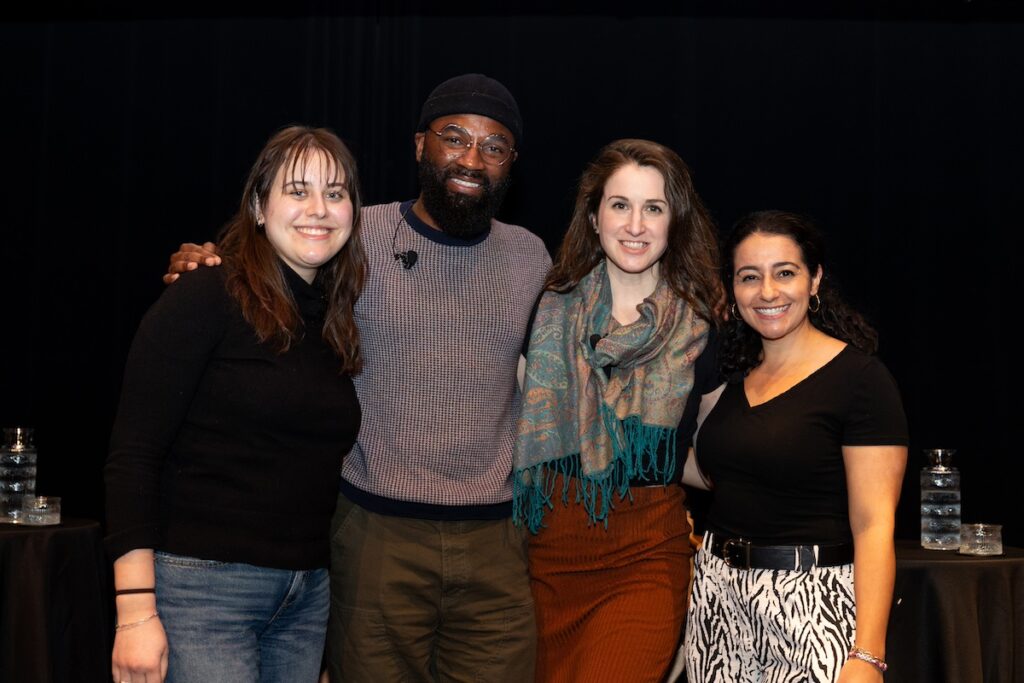
Here’s how the panelists think about those four crucial skills:
Relationship Building
Networking is great, but relationship building is more lasting.
“How do we make this about … community-building with each other—making less transactional and more symbiotic relationships? Because most of your fields are actually very small, and you’ll probably be working with the same people for years and years to come.” —Ari Conte
Banish the phrase, “I want to pick your brain.”
“No one wants their brains picked. Let’s be more specific when you’re reaching out to people. Let’s say, ‘Hey, I saw Suffs, I really loved it. I’d love to talk to you about what that audition process was like. I’m working on something myself that has to do with women’s history and I’d love to know about the development.’” —AC
Be considerate of people’s time, but don’t be afraid to ask for a small amount of it.
“I want to challenge you … if you are in a line at the theater for the restroom and you see someone you’d really like to talk to, get up the courage and go say hello. Respect people’s boundaries and privacy, of course, but getting face time with someone is always going to be more valuable than an email or a DM, right?” —AC
Finding friends and mentors can take a lot of groundwork.
“It took a lot of showing up to the industry networking event … it took a lot of that in-person hello, sending the follow-up email, reminding people who I was after they met me. Maybe a few beers were involved.”—Piper Phillips
Be a “great collaborator.”
“I say in my class all the time, we are past the point of being so talented that, excuse my language, you can be an asshole. It’s so much more important to me that you are a joy to work with. There are so many talented people, and you need to be a great collaborator.” —Alex Lonati
Adaptability
Look often and honestly at your finances.
“You’re going to make different amounts of money throughout your career and throughout the year; give it a lot of time and attention. I go through my finances quarterly, thinking, ‘OK, when do I have time to work on my own show, my creative project, and when can I fit that in my financial puzzle? When am I making more money over here, and can build up a nest egg so I can do that project later?’” —Ari Conte
Even small opportunities are valuable.
“Maybe you don’t get the dream job right after school—you probably won’t, right? It’s a journey. So you might have other opportunities that feel small and feel like not exactly what you want. Go down your checklist and think about what else you can gain from a small opportunity. Maybe it’s not the money that you need right now, but maybe it’s going to connect you with that relationship.” —AC
There are so many ways to get a result.
“So much of adapting is [that] everyone’s an individual with their own background. I work with a lot of people who are not American … I’ve been working with a lot of British designers and [learning to] just be open and ready when they’re like, ‘We don’t do that where I come from.’” —Piper Phillips
Know Yourself
Exercise your intuition.
“I think that intuition is a muscle, it’s something we have to practice … start now. Take a breath and think about what your gut instinct is for that decision. You can still go ahead and ask [friends and family] their thoughts, but start practicing what it feels like to make those decisions yourself.” —Ari Conte
Pace yourself.
“I practice using energy hours. I have found the times of day where I have the most focus, the most creativity, and I prioritize those hours to do the things that are most important to me. My energy hours are about 9 a.m. to 1 p.m. That’s not the same for everyone.” —AC
You don’t have to be in New York to make theater, you don’t have to go to LA to make films.
“I worried a lot that there was almost something wrong with me in that I didn’t feel that pull to New York. I love to go to New York, New York’s so much fun, but I really wanted to be able to carve out a place for myself faster, and I was worried about being able to do that in such an enormous city.” —Alex Lonati
“I felt like if I’d come to New York, I would have been so overwhelmed, having come from a small town. I would have wanted to go out in Hell’s Kitchen all the time and would have been boy crazy— just being honest.” —Todd McNeel
Don’t settle for one path if your interests diverge. Go down both roads.
“I always knew that I wanted to be a performer, but I had other interests. I had written for the school paper, I had a communications minor in college, and had had advisors on both sides, both in the performing arts department and in communication, saying that you couldn’t make both work… So I moved to Boston, had gotten into the fellowship program here, and Emerson just exposed me to a lot, and also taught me that I could do these things.” —TM
Categories
