Studying Ways to Study
When Stella Lapidus ’26 first read the syllabus of Professor David Kishik’s “Special Topics in Philosophy: Study Studies,” they thought they were missing something.
No essays, no research papers, no exams. No homework, really, apart from editing a transcript of each hour-long class discussion. To prepare for those discussions, students can read the course texts, or have the texts read to them by artificial intelligence, or both at the same time.
“I [thought], ‘We’re going to get to class and he’s going to say there’s more,’” Lapidus, a Writing, Literature and Publishing major, said.
The course is described in the catalog as a “class about being in class,” an “experimental and unorthodox” meta seminar that asks students to read and discuss texts from Plato to bell hooks and grapple with their own ideas about what education should or should not be.
But Study Studies is not just a class—it’s the third of a planned five-part series of acts of “practical philosophy” Kishik is undertaking that hovers somewhere between philosophical laboratory and performance art. In the first, “Transcription,” Kishik hand copied his earlier five-volume series, To Imagine a Form of Life, into 10 notebooks. For the second, “Conversion,” he tried to exchange defaced, devalued U.S. coins for intact ones in New York’s Washington Square.
Study Studies (or, in the context of his practical philosophy series, “Education”) is also, according to Kishik, an attempt to capture students’ fractured and diffused attention using a combination of AI-powered technologies, ultra-analog devices, and human dialogue. It’s a method that’s attracted attention from the philosophy community and academia at large, with notices in Daily Nous, a news vehicle for philosophers, and The Chronicle of Higher Education.
Kishik said in his experience, students are not generally quick to embrace AI, and in fact, seem skeptical of it. But they are distracted – by their devices and the constant onslaught of content and information, and over the years, students’ capacity for sitting down and reading lengthy works or for writing lenghthy papers has diminished.
They’re primed for dialogue and community, and they’re looking for someone to guide them on their exploration of new ideas.
“It’s an ‘everything, everywhere, all at once’ experience of life, and the ability to actually have someone [who] decides, ‘This is the text to be read and let’s talk about it together, and let me try to explain it to you, but we’re all explaining to each other,’” Kishik said. “This whole process is, I think, today necessary for their souls,” Kishik said.
How It Works
Students are assigned weekly texts — “The Art of Writing” from Plato’s Phaedrus (370 BC), Ralph Waldo Emerson’s “The American Scholar” (1837), and hooks’ “Teaching to Transgress” (1994). They can read them the old-fashioned way, they can listen to AI-generated “recordings” of the texts, or they can listen and follow along on the page.
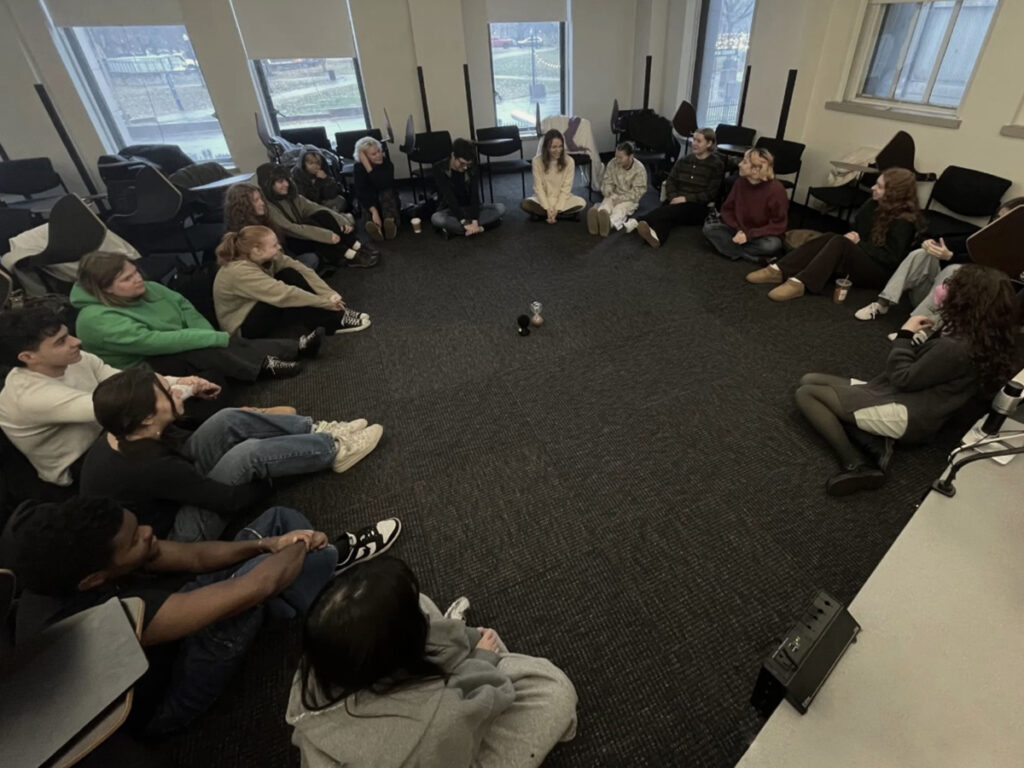
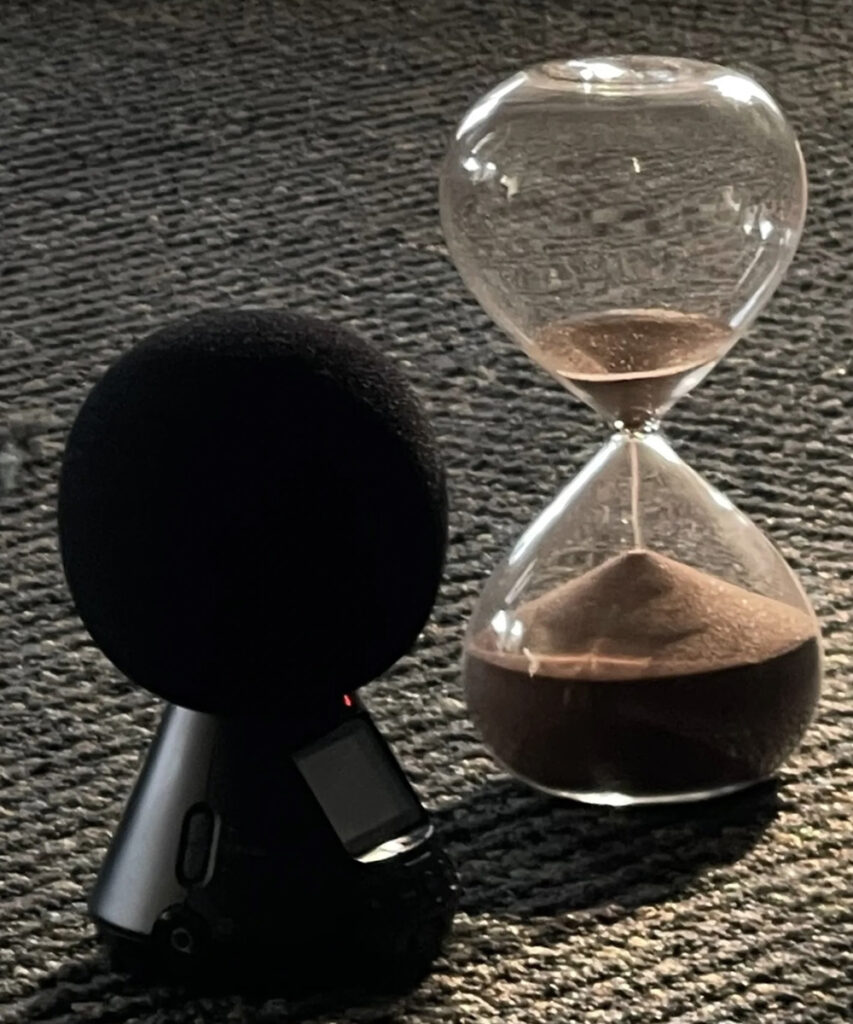
Once in class, they are captive to the ideas and each other. They sit on the floor around an hourglass, which marks the time for them because they are not allowed to use any electronic devices, or leave the room unless it’s an emergency.
“It’s like sitting around the fire. And actually, I have a student this semester [who] brings in this … lantern that looks like fake fire and just puts it next to the hourglass and the microphone,” Kishik said.
The microphone is there to capture their conversation, which is then transcribed (again, with AI) and put into a Google doc. Their only assignment outside of class, beyond reading the texts, is to edit their contributions to the in-class discussion. This is their chance to take out the “ums” and “likes,” for the more reticent or writerly students to clarify or expand their thoughts, and for the more outspoken students to edit themselves down.
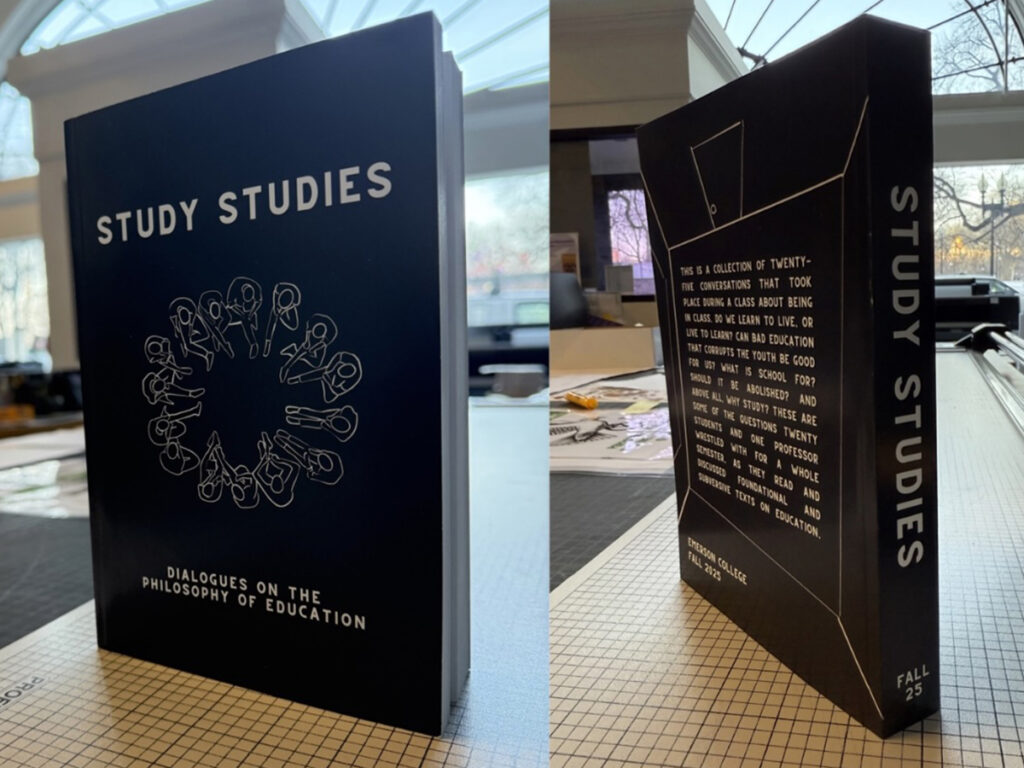
At the end of the class, this Google doc—a polished record of their Socratic dialogue—is published in a short-run printing and given to each student. Kishik keeps a copy for himself, and donates a few to the Iwasaki Library.
How Meta
Just as educators and students at every level of the academic enterprise grapple today with the profound implications of AI on teaching and learning, the philosophers Kishik and his students discuss in class wrestle with their own anxieties around new ways of understanding. In the first reading, from Phaedrus, Plato depicts his teacher, Socrates, criticizing the act of writing, which Socrates believes compromises a person’s memory and recall.
“We start with this text just to think about that very idea, that you have a technological innovation that is introduced into the classroom, or into life, and then what happens to your skills? What happens to your life?” he said.
Kishik may not take as dim a view of writing as Socrates, but he recognizes that in the age of AI, “everybody can write anything.” It won’t be as good as something written by a skilled human, but it’s getting better by the day.
The deep listening and dialogue that happens in Kishik’s class, however, is a skill that he believes will be critical to anything his students do in their lives.
“To be able to speak in public with each other, and to have an intellectual, philosophical conversation about anything—thinking on your feet—that’s the main skill that I want them to have,” Kishik said.
How Novel
Stella Lapidus, the student who was taken aback at the syllabus of Study Studies, said they felt a bit like a “fish out of water” at the beginning of the class, since they’re someone who feels they write better than they speak. But they appreciated the chance to develop a new skill, and in the end, they found the discussions more valuable than the editing time.
“I think the thing that matters the most is the initial in-class discussion, because that’s where the other people are actually listening and engaging with you in real time,” they said.
Media Arts Production major Robby Waters ’27 said the class felt to him like a true conversation between 20 people. It was also an antidote to an educational tradition that can feel transactional: professor imparts knowledge, student submits work.
“For me, that’s a very beautiful thing, because it’s emphasizing the importance not of what you get out of education, but the importance of education itself,” Waters said. “And what I get out of the class isn’t a tangible thing that I can write down and point to, it’s a new synthesis of ideas that I got from sharing my ideas, having them challenged by other people, seeing it from new perspectives.”
Kishik said this paradigm for education could work in any class that is based on reading, and, crucially, is small. If there’s too many students, the intimacy and give-and-take is lost.
He’s betting on a future academia where listening and speaking will take a pedagogical “front seat,” and that AI will get in on it too, with devices that allow you to speak to them and carry on complex conversations.
“I think that this is the future, in many ways,” Kishik said. “When I talk about it with students, they’re like, ‘Yeah, please bring it about, we’re sick of our screens.’”
Categories
