Teach-In on Timely Topics Explores Public Knowledge in a Time of Change
As Emerson College continues its commitment to addressing urgent societal questions, this year’s Teach-In on Timely Topics invited the community to examine the theme of Public Knowledge, Memory, and Legacy.
“The question is not whether public knowledge will change,” said Shaya Gregory Poku, Vice President for Community, Culture, and Belonging. “It will. The question is: By whom? To what end? Public knowledge, memory, and legacy are the bedrock of democratic life.”
The four-day forum, which began March 2, is a collaborative initiative of the Office of the President, the Office of the Provost, and the Division of Community, Culture and Belonging. The annual program seeks to engage topics at the intersection of expression, inclusion, and society, rooted in Emerson’s strengths in communications and the arts.
Throughout the week, additional sessions themed around Public Knowledge, Memory, and Legacy were offered, including a workshop on poetic lineage from affiliated faculty member Livia Meneghin; a panel with the Emerson Prison Initiative (EPI), New Beginnings Reentry Services, and Ritual4Return (R4R); a playmaking puppet workshop with ArtsEmerson and the artists from Dead As a Dodo; a ProArts Consortium panel interrogating truth and visibility; and a presentation on digital storytelling through the lens of Caribbean women in diaspora tradition from Winelle Felix, associate director of the Elma Lewis Center.
A keynote panel held March 4 at the Paramount Center brought together Michael Bobbitt, President and CEO of OPERA America, and Roosevelt Montás, the John and Margaret Bard Professor in Liberal Education and Civic Life at Bard College.
Emerson College President Dr. Jay Bernhardt opened the keynote by emphasizing the urgency of such dialogue, particularly during an era of technological transformation driven by mass communication and artificial intelligence.
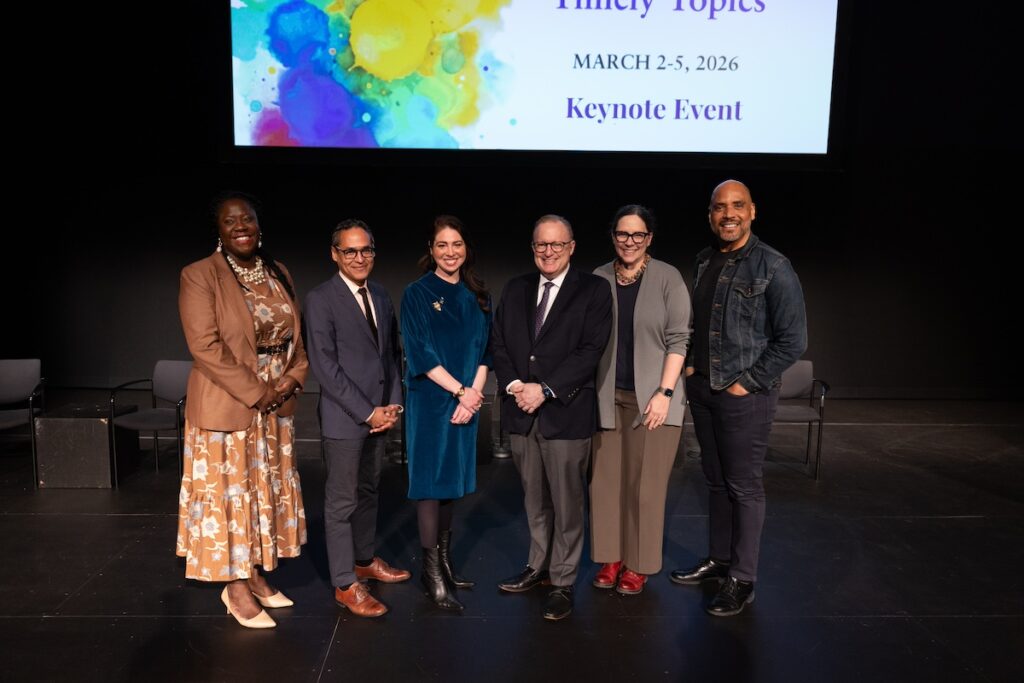
“Here at Emerson, we believe in the power of art and communication to positively impact the world,” said Bernhardt.
Amber Lee, Writing, Literature & Publishing Assistant Professor, moderated the panel discussion and began by asking Montás what resonated with him most about the theme.
“Public knowledge, memory, and legacy is what shapes us, our sense of self is in fact rooted in a deep past,” answered Montás. “It gives us a sense of the possibilities through which we can construct our future.”
Bobbitt agreed and added, “Memory and legacy feel like mechanisms through which we can democratize public knowledge.”
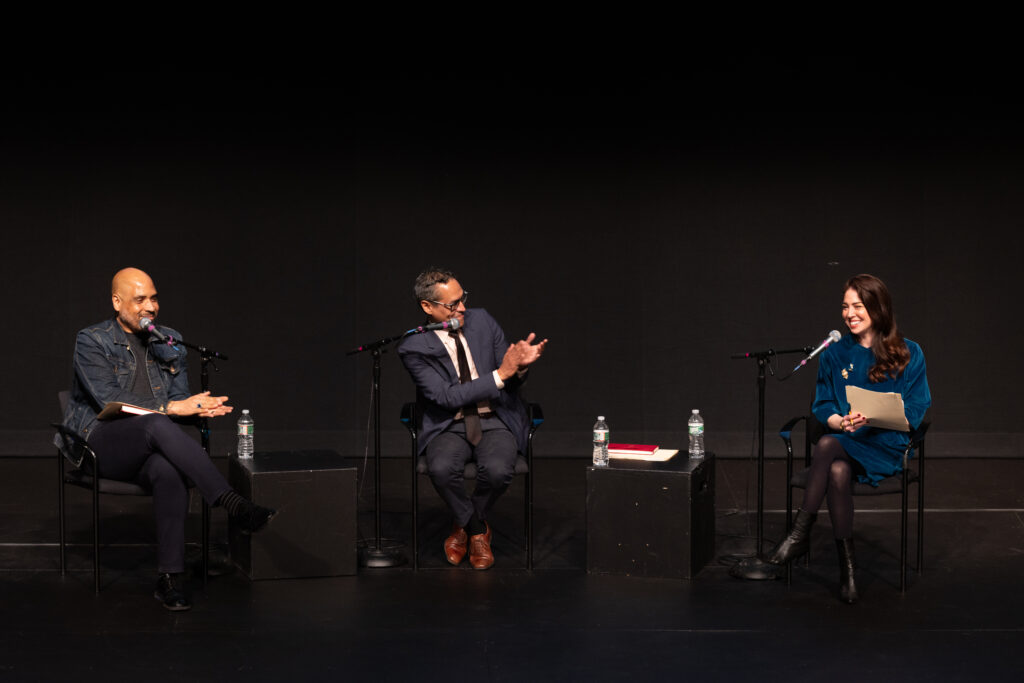
(Photo by Derek Palmer, MA ’20)
As the discussion turned to the difference between public knowledge and mere exposure to information, the panelists reflected on the challenges of navigating an era defined by abundance.
“Today, our challenge is curating an over-abundance of information to create knowledge,” Montás said. “Public knowledge is collectively constructed. It involves our participation.”
For Bobbitt, the distinction lies in interpretation—the freedom not simply to consume information, but to engage with and reshape it.
Lee then asked how institutions like OPERA America and Bard College can serve as stewards of this co-created knowledge.
“Organizations like ours can become truths-seekers,” said Bobbitt. “Truths in plural, because there are multiple truths.”
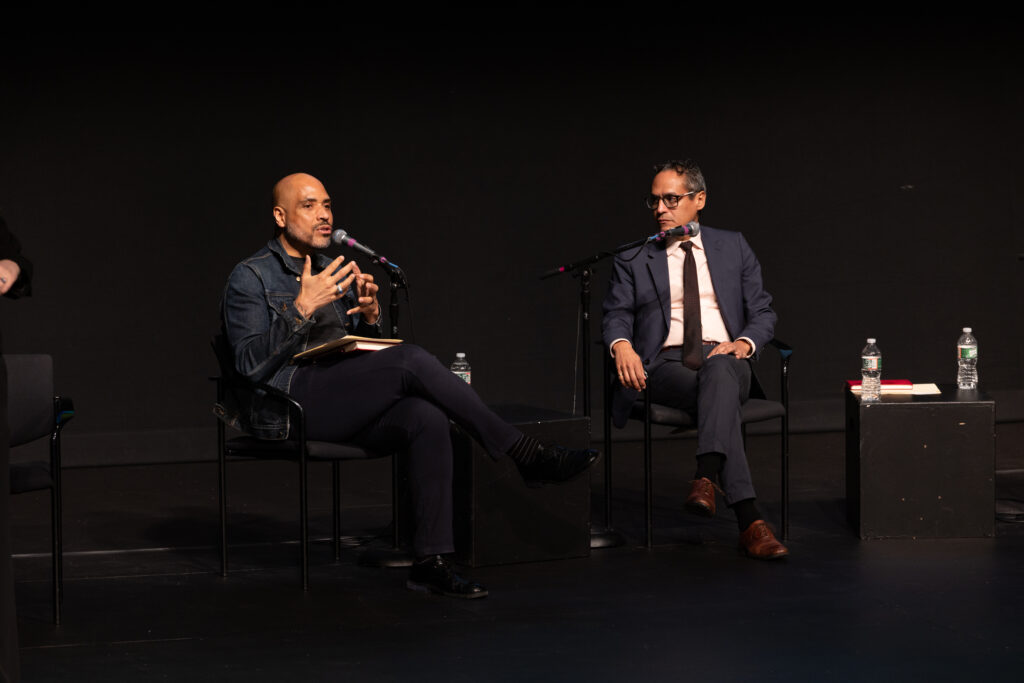
Montás emphasized the necessity of historical awareness in that work.
“To the degree to which we are blind to the past, we fly blind into the future,” he said.
As the conversation moved toward the interplay between memory, tradition, and progress, Bobbitt posed a rhetorical question that underscored the importance of historical context: “Without the past, how are we supposed to know we are doing better?”
Montás encouraged the audience to look for patterns across time to consider the parallels between past and present moments, especially in periods of uncertainty.
The keynote concluded with a reflection on legacy—not only what individuals leave behind, but what they inherit. “We are part of a chain of legacy that starts behind us, and continues ahead of us,” said Montás.
During the discussion, a central theme emerged: public knowledge is neither fixed nor neutral. It is constructed collectively, shaped by memory, and carried forward through institutions, art, and civic engagement—a process that Emerson’s Teach-In on Timely Topics seeks to examine.
Throughout the week, additional sessions themed around Public Knowledge, Memory, and Legacy were offered, including a workshop on poetic lineage from affiliated faculty member Livia Meneghin; a panel with the Emerson Prison Initiative (EPI), New Beginnings Reentry Services, and Ritual4Return (R4R); a playmaking puppet workshop with ArtsEmerson and the artists from Dead As a Dodo; a ProArts Consortium panel interrogating truth and visibility; and a presentation on digital storytelling through the lens of Caribbean women in diaspora tradition from Winelle Felix, associate director of the Elma Lewis Center.
Categories
