
Q&A: Crafting ‘Soul-Rattling’ Fear with Owen Egerton
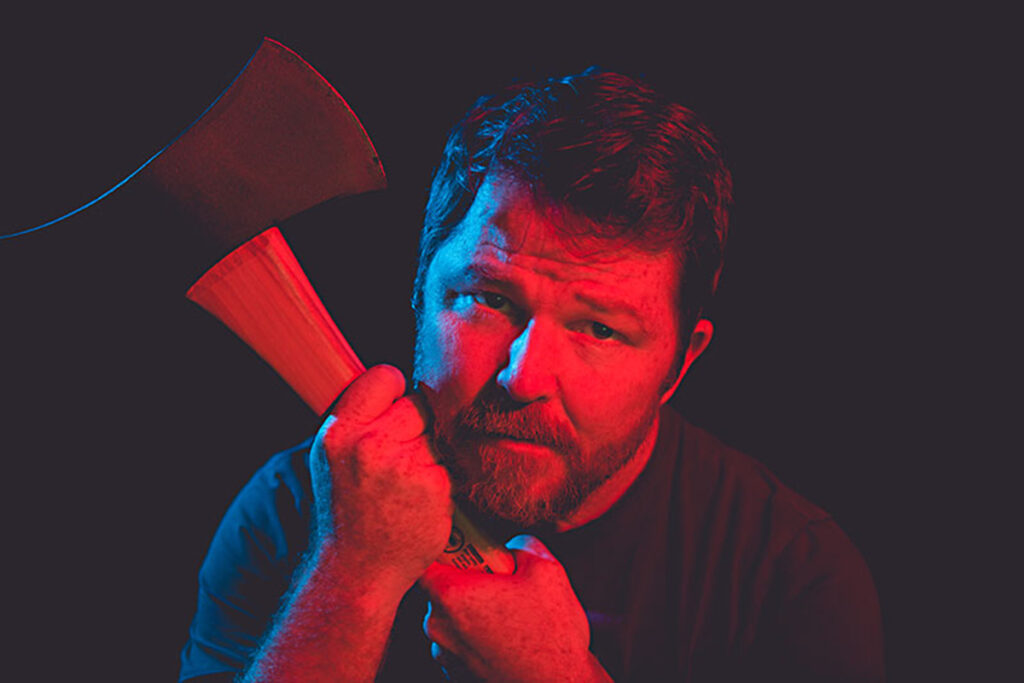
Screenwriter, novelist, and School of Film, Television, and Media Arts Assistant Professor Owen Egerton is fascinated by the “temporal vertigo” that happens when we hold something ancient and unknowable in our hands.
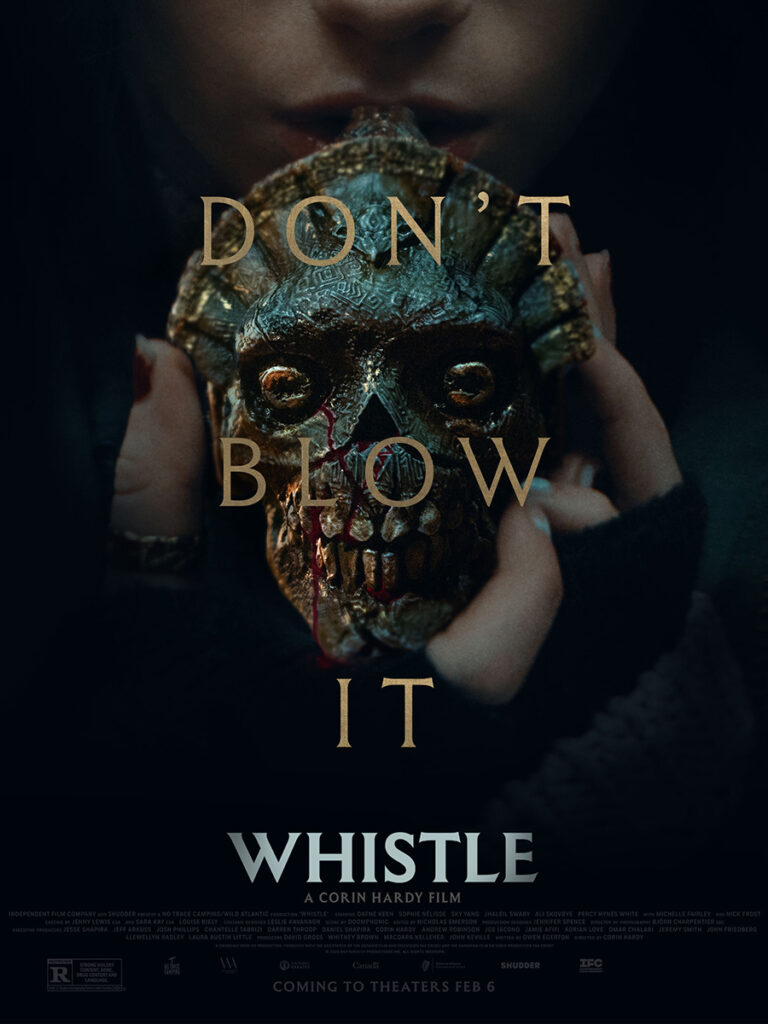
In his latest horror film, Whistle, directed by Corin Hardy, that ancient and unknowable object is an Olmec “death whistle,” a skull-shaped ocarina that summons the blower’s demise – as fate intended, but ahead of schedule.
Whistle premiered at Fantastic Fest last fall, and is in theaters (including AMC Boston Common) now. Emerson Today asked Egerton about the historical and metaphysical origins of the film, why teenagers always seem to be the ones who end up dead in scary movies, and the most terrifying thing Egerton’s ever seen on a screen.
What is it about ancient artifacts that is so creepy?
I do love an artifact. Doesn’t even have to be that ancient. The random polaroid that falls out of a library book that hasn’t been checked out for 30 years. The theater ticket in your grandfather’s old coat. The chipped coffee mug on a stump in the middle of the woods. They all feel like pieces to a puzzle you have no hope of solving. They have meaning – but you aren’t privileged to what the meaning is. That draws me in every time.
The older the artifact – or historical site, or legend – the heavier the mystery. We feel the gravitas of time. We can hold something that has existed so much longer than our lives. We can touch something older than our country. It feels a bit like standing on the edge of a cliff – the temporal vertigo. I love that uneasy awe.
How did the device of an Olmec death whistle come to you?
I’ve been fascinated with pieces of art from throughout history and across the world that are crafted to remind us we are going to die. Paintings, sculptures, Tarot cards, prayer books… even horror movies. These whistles may be part of that tradition. The first time I heard one of these whistles blown, I was fascinated and terrified! They have been found in graves across Mesoamerica -beautifully crafted creations. Some theorize they were used by armies, the shrill scream announcing the attack of hundreds of warriors. Another theory was that the whistles were a tool the recently dead would use to summon a guide to lead them through the afterlife.
I started thinking through possible mythologies and what would it happen if this landed in a place it never belonged, used by people with no understanding of its origin and purpose. My thinking is our Whistle is the first – the most ancient – of these style of artifacts. It has passed through dozens of cultures, each leaving its mark. And it has claimed hundreds of lives.
Whistle’s director, Corin Hardy, worked with Spanish sculptor Daniel Carrusco to make the film’s whistle – and more and more it took on a life of its own. It watches the characters, calls to them, all with its unsettling skeletal grin.
So many horror films, including Whistle, feature teens. What about the age group appeals to you?
There’s a wild energy in our teen years when we begin to understand our own mortality – and we begin to flirt with it. Whether it’s drag racing or Ouija boards or slasher films, we start exploring the taboo ideas around death.
I feel a horror movie should have as much life as death. Teenagers are out there discovering and exploring and falling in love and getting their hearts broken. They are alive… which makes it all the more terrifying when death starts hunting them.
How do you balance plot, characterization, and adrenaline?
You weave them all together, like you’re braiding hair. You find your plot in your character. You know your character in how they respond to the challenges that make up the plot. And the audience’s adrenaline is inspired by investment in a character in a thrilling or dangerous situation. That’s the short answer. You’d have to take one of my classes to get more.
What’s scarier: blood and gore or supernatural chaos?
Give me all three, please! I love a good jump scare. I even love a not-so-good jump scare. I also get a kick out of a gory shock. And I love some ghosts throwing tantrums.
But I think the scariest of films touch on the uncanny. They show us the world is not what we think or feel it should be. Something is wrong, strange, weird. This is more of a soul scare.
Think about the two little girls Danny meets in the hallways of the Overlook Hotel in The Shining. Those girls don’t have any weapons. They are not attacking or screaming. They are no real threat. But they should not be there. Their presence says the world is not what we understand it to be – and that terror goes deep. It rattles the soul.
What is the most terrifying scene you’ve seen in any film to date, and why did it freak you out?
For me it’s Texas Chain Saw Massacre, Tobe Hooper’s 1974 grimy, gritty masterpiece. It was made on a dime, the film texture is grainy, the production design strange and haunting.
There’s a feeling that you shouldn’t trust the filmmakers. They’re young, inexperienced, out of the safe system. It feels from the start like they might show you something you never wanted to see and will never be able to unsee. The film feels like a dream – beautiful and weird and full of art. There’s strange logic, unnerving sounds, an alien world right within our own. You can smell the chickens, feel the Texas heat, taste the dirt and sweat and sausage. I can never casually watch this film. I sit, I stare, I dig my nails into the couch pillows. Like the best of all cinema, it somehow mesmerizes me.
What are you working on now?
When I’m not teaching, I’m working on a few different projects, including a thriller for Fox Searchlight and a screenplay adaptation of one my novels. And I’m always keeping my eye open for what frightens me, intrigues me, and thrills me – searching for the next idea.
Categories
