
Waveforms Takes Over Paramount with Multimedia Art Show
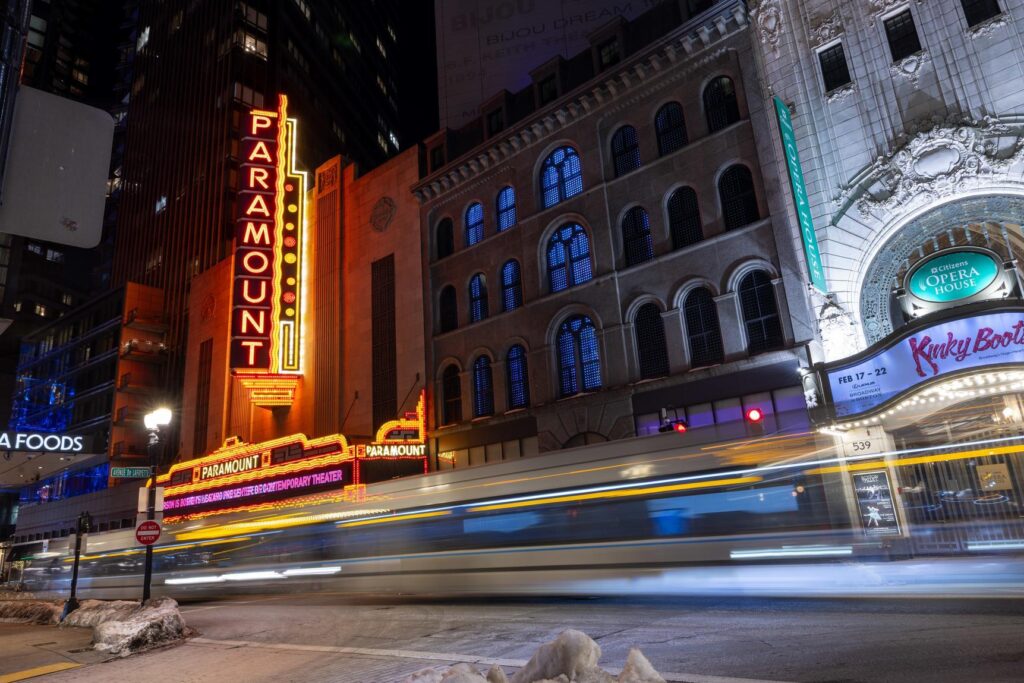
The LED Media Facade on the building’s exterior illuminated Washington Street with captivating visuals. (Photo by Luis Gerardo Del Razo Tamayo, MA ’26 ) 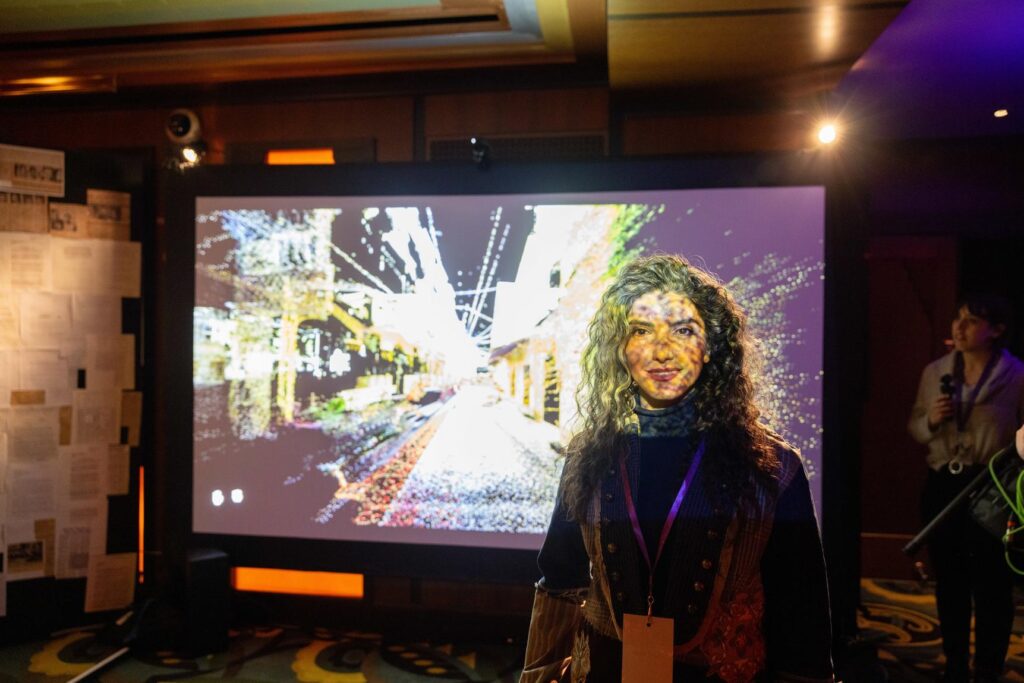
Asma Khoshmehr’s ’22, MFA ’24 installation work provided a visual journey through East Africa, chronicling Khoshmehr’s mother’s escape from forced marriage in Zanzibar. (Photo by Luis Gerardo Del Razo Tamayo ’26) 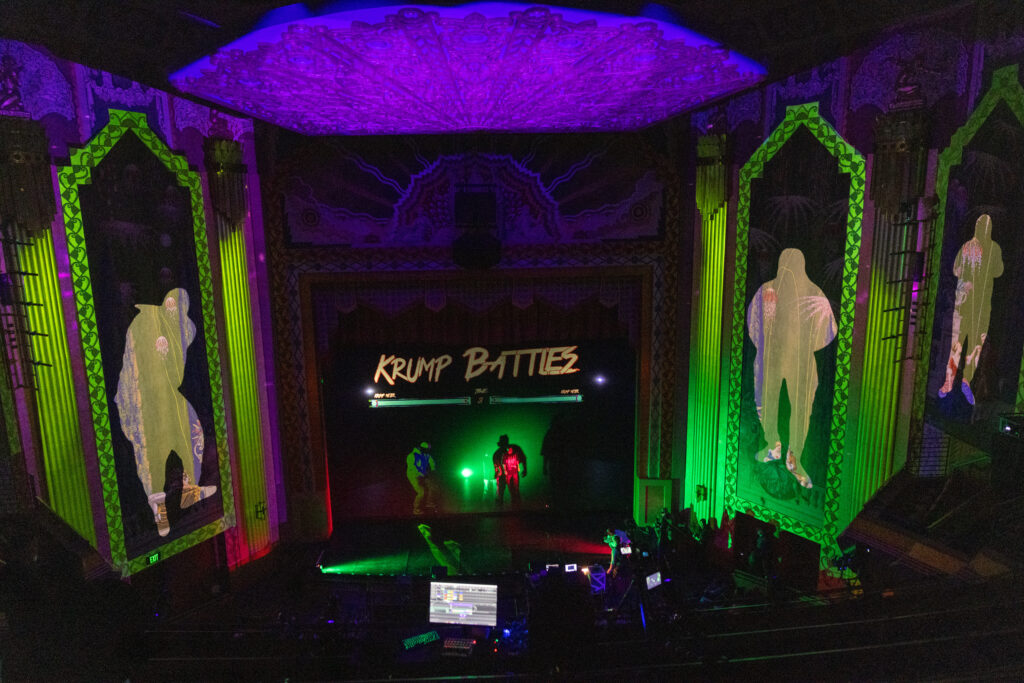
Waveforms included Krump Battles (Photo by Luis Gerardo Del Razo Tamayo, MA ’26 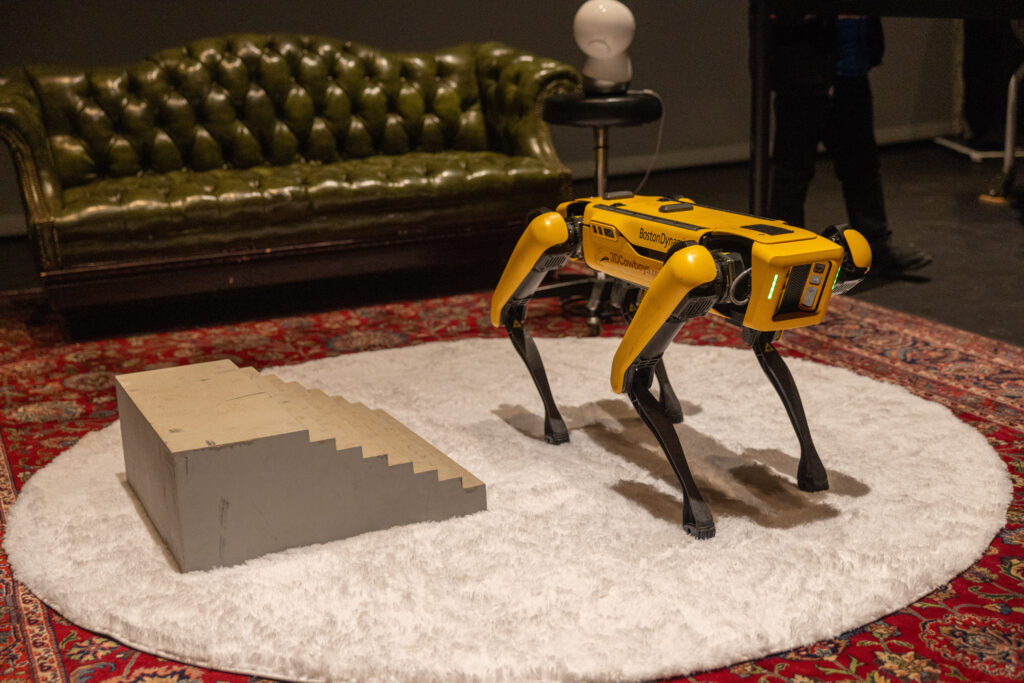
Spot, a robotic dog developed by Boston Dynamics, participated in the Waveforms experience through collaboration with 3D Cowboys founder Michael Quan. (Photo by Luis Gerardo Del Razo Tamayo, MA ’26) 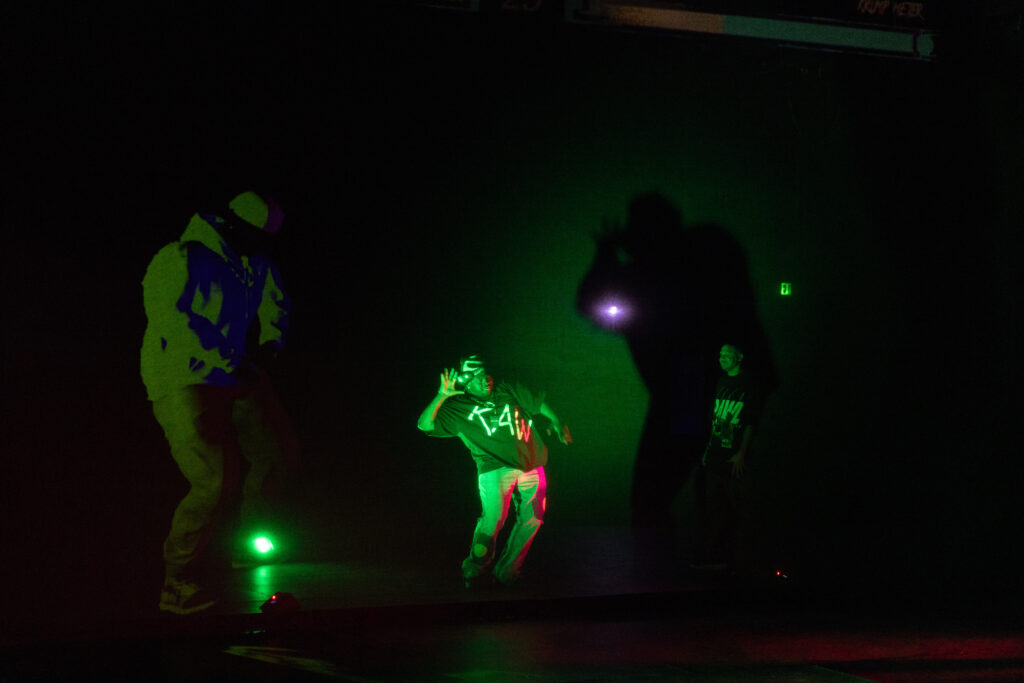
A musician performs during a Krump Battle. (Photo by Luis Gerardo Del Razo Tamayo, MA ’26
For one evening last week, the Paramount Center became a laboratory of imagination, thanks to Emerson students, faculty, alumni, and creative partners.
Light flickered across walls. Data became narrative. A robotic dog stood center stage. On February 12, Emersonians gathered for the third annual Waveforms: A Multimedia Art Occurrence, transforming the space into an immersive landscape of projection, performance, and participatory storytelling.
Presented by the Museum of Science (MoS), MASARY Studios, and Emerson College—with collaborations from Boston CyberArts, Illuminus Boston, the MIT Spatial Sound Lab, and AVFX—the evening activated every corner of the venue, inviting audiences to reconsider the intersection of art, technology, and storytelling.
Each stage within the Paramount offered a distinct experience, from innovative installations questioning technology’s role in daily life to artistic interpretations of statistical data that reshaped how information can be understood. Emerson students, faculty, and alumni played integral roles throughout the event, bringing their perspectives on narrative and installation art to life.
For attendees, Waveforms began before they even stepped inside. The LED Media Facade on the building’s exterior illuminated Washington Street with captivating visuals. One of the featured artists was Film and Media Arts student Jingyuan Yang ’26.
“I’m very happy for the opportunity to share my work at this level; it’s the first time the public has seen it,” Yang said. “When you spend a lot of time working on something like this, you want as many people as possible to see it.”
Yang created their exhibition, Pounce, as part of the class Experimental Media Production, taught by School of Film, Television, and Media Arts Professor Kathryn Ramey. Through bold color and layered sound, the piece explores the unpredictability of growth and the chaos inherent in change.
“It’s abstract and chaotic, like us when we are growing up,” Yang added.
Inside the Paramount, visitors were greeted by Act #6: 1001 Nights in Zanzibar, an audiovisual installation by Asma Khoshmehr ’22, MFA ’24. The work invited guests to interact with a visual journey through East Africa, chronicling Khoshmehr’s mother’s escape from forced marriage in Zanzibar.
“Presenting here is a lovely and amazing opportunity,” Khoshmehr said. “With this exhibition, I aim to tell people how important sharing your story is, especially when it is a silent story like this one.”
The installation projected the physical path her mother traveled, using footage Khoshmehr recorded on site. Through motion sensors, attendees could shift colors and redirect the camera’s perspective, while recordings from Khoshmehr’s uncle and his wife filled the space through surround sound—creating a deeply personal, participatory experience.
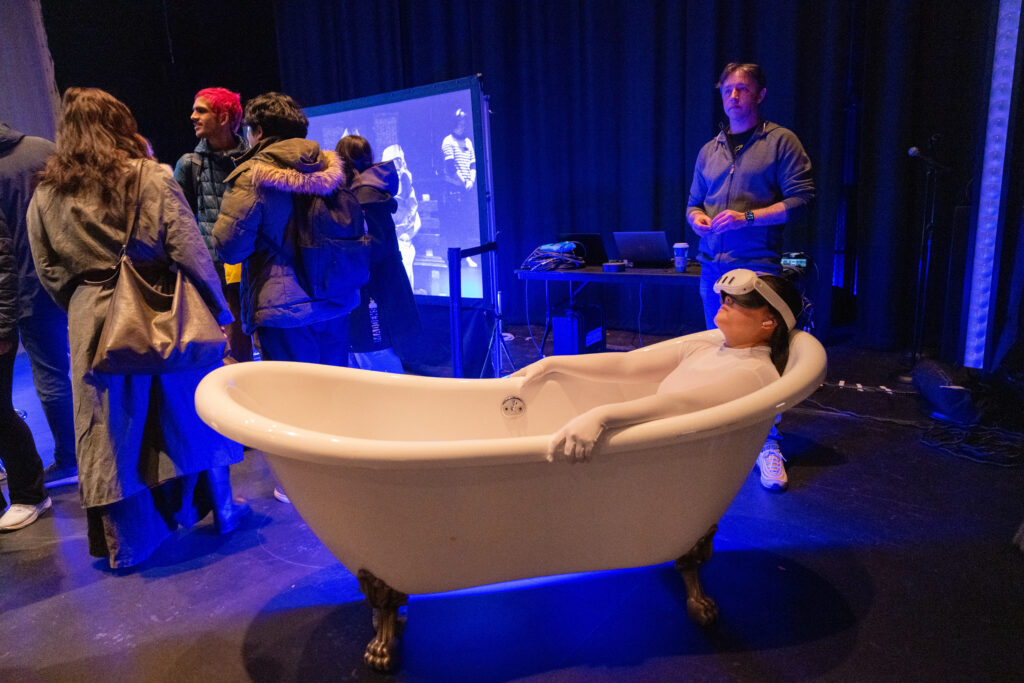
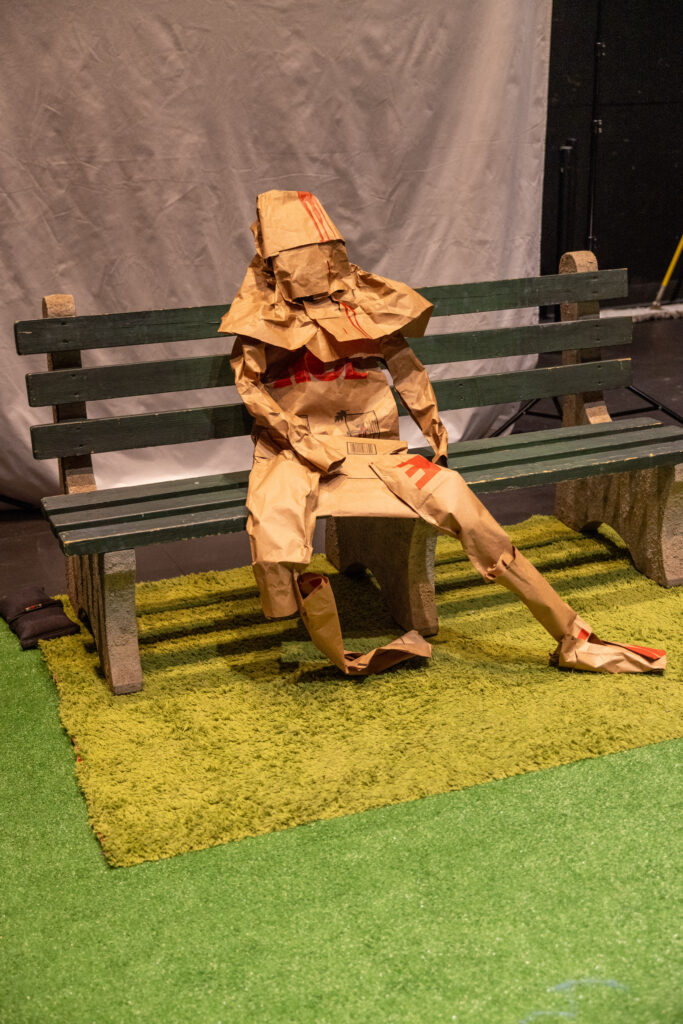
Farther inside the Paramount, School of Film, Television, and Media Arts Assistant Professor Daniel Pillis and his Installation Arts class transformed the Robert J. Orchard Stage into a meditation on the relationship between object, body, and space. The visually arresting exhibition featured student performers interacting with constructed environments: Sammy Li ’29 reclining in a bathtub while wearing a VR headset in an installation by Avery Cather ’26; Charlotte French ’29 was stepping inside an iron lung while wearing headphones in an installation by Bea Downey ’26; and Niko Rincon ’27 sat on a park bench cloaked in paper bags in an installation by Emery Frost ’27.
“This exhibition investigates how the body is transformed and shaped by different structures,” Pillis said. “It studies how technology challenges our evolution and cautions against becoming too passive in the face of emergent technology.”
At the center of the stage stood Spot, a robotic dog developed by Boston Dynamics, participating in the Waveforms experience through collaboration with 3D Cowboys founder Michael Quan.
On the second floor, Journalism Assistant Professor Lina Giraldo presented two data-driven installations that encouraged audiences to rethink how statistics are interpreted and understood.
Her piece Data Para Todes paired median household income data with demographic context, including race, to promote greater data literacy across Massachusetts communities. By visualizing numbers as narrative, the work revealed the human stories embedded within statistics.
“My work here is concerned with the democratization of data and data literacy,” Giraldo said.
In a second installation, Giraldo explored environmental noise through data based on sound-level measurements collected in Antwerp, Belgium. The piece asked viewers to confront the distinction between “good noise” and “bad noise”—the difference between children playing outside and the roar of highway traffic—transforming raw measurement into layered storytelling.
Through collaboration and experimentation, Waveforms demonstrated the powerful, introspective possibilities that emerge at the intersection of art and technology. The evening was more than an exhibition– it was an experience that challenged audiences to see, hear, and interpret the world differently.
Categories
