
Creativity@Emerson Workshop Builds Critical Skills for Any Endeavor
In your head or on a scrap of paper, draw a vase. What does it look like? Tall or round? Does it have handles?
Now, draw something that holds flowers. Did you draw a variation on a vase? An outstretched hand? The earth?
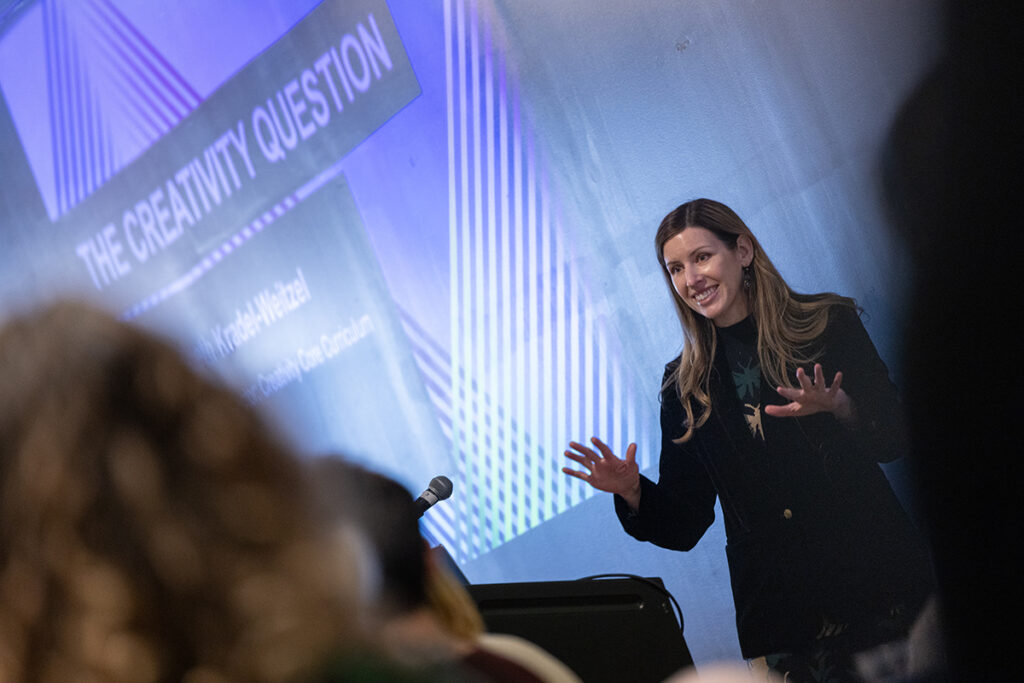
This exercise demonstrates “convergent” vs. “divergent” thinking, terms coined by psychiatrist J.P. Guilford in 1956 and used frequently in the study of creativity. It was one of several activities students and faculty were given in a February 9 workshop led by Maribeth Kradel-Weitzel, assistant provost and director of the Creativity Core Curriculum at Thomas Jefferson University in Philadelphia.
The event, “The Creativity Question,” was the latest event hosted in connection with the Creativity@Emerson initiative, which seeks to build a common language around creativity on campus and how it’s integrated through every discipline. It was one in a series of workshops Kradel-Weitzel held with students and faculty on a daylong visit to campus.
“Maribeth Kradel-Weitzel demonstrated beautifully to our students and faculty that distinct and intentional creativity training can improve our self-awareness and our ability to look at problems from different perspectives,” said Marketing Professor Thomas Vogel, an international expert in the field of creativity who is spearheading Creativity@Emerson.

The prompt to draw “a vase” focuses on a “what,” Kradel-Weitzel said, which tends to lead to convergent thinking: We’ve all seen a vase at some point and so draw what we know. Asking people to draw “something that holds flowers,” however, focuses on a “why,” and leads to participants to explore multiple solutions — that, she said, requires divergent thinking.
“One is not necessarily better than the other,” she told a packed Loft. “But in a typical creative process, you’re going to start by going far and wide, thinking very divergently, then go through some number of cycles of getting convergent.”
Why Teach Creativity?
The data is in, and it has a lot to say about creativity’s pivotal role in a dynamic workforce. According to the World Economic Forum’s 2025 Future of Jobs report, some of which Kradel-Weitzel shared with the workshop, top executives from across industries and countries ranked creative thinking fourth among core skills required in 2025, and fourth among “skills on the rise,” behind only AI and big data, networks and cybersecurity, and technological literacy.
We are experiencing a “fourth industrial revolution,” she said, characterized by artificial intelligence, data connectivity, power analytics, and advanced robotics, among other hallmarks.
“Human creativity skills are absolutely essential in this landscape, and there are a lot of studies that demonstrate this and show this is a shared belief among industry leaders,” Kradel-Weitzel said.
That’s why it’s important to teach creativity. The how can be seen in the series of exercises Kradel-Weitzel led students through, including the vase/flower holder activity.

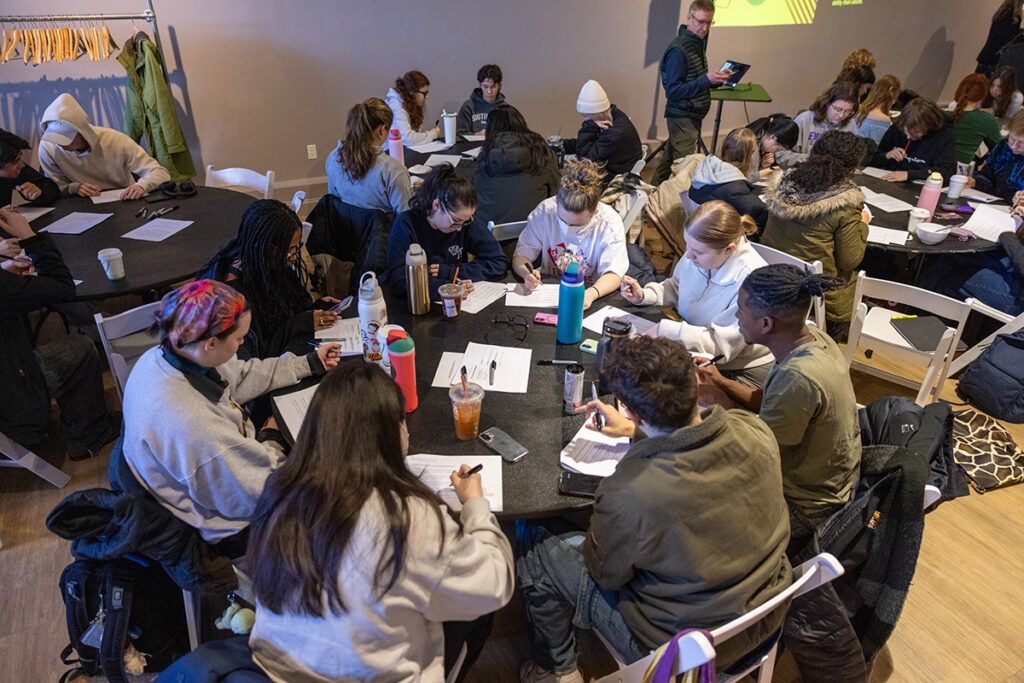
In another exercise, students were presented with a blank page and asked to draw “100 different arrows.” How they interpreted that command told a story about how each approaches problem-solving: Did they focus on the word “different,” taking care to create unique and visually striking arrows? Did they fixate on the “100,” prioritizing efficiency over aesthetics? Did they sit back and wonder why anyone would want 100 different arrows in the first place?
One exercise asked students to turn random-seeming squiggles and lines into doodles; there were two sets on a page, separated by a dividing line. Kradel-Weitzel then showed them examples from previous workshops, including some who turned the page upside down to create their drawing, or who used both sides of the page, with the dividing line as an element in the picture.
Her point: That when presented with a problem, they should consider assumptions and resources. Did they assume they could only select one set of lines to create their doodles, or that they had to use them right side up? Did they look at everything on the page, including that unassuming dividing line, as an untapped resource?
“How many times do we create rules that are really just in our heads that no one is actually imposing on us? And what new creative opportunities would be available to us if we didn’t do that?” she said.
Putting It to Work
Eric Hogue, Assistant Professor of Marketing Communication, attended the workshop with his Business Strategy Into Implementation capstone class. As someone who has worked in product development, Hogue said he has had some creativity training, and appreciated the exercises Kradel-Weitzel led.
“Most of us need structures in place to know, how do we diverge on hundreds of ideas, then converge on something that we can actually develop?” Hogue said. “I will take what we learned here and build on it in my classes with specific use cases. There are a number of different kinds of what we call ‘ideation skills’ that we will use, because the reality is strategic planning … is very creative.”
Bailey Carr ’26 is an interdisciplinary studies major who designed their own Story and Self program, combining courses from the School of Film, TV, and Media Studies, and psychology. Carr said the workshop got them “thinking outside of the box.”
“I feel like I already had a pretty diverse understanding of creativity and how it can apply to pretty much any discipline, but this did give me some helpful strategies in my own creative practice,” Carr said.
Media Arts Production major Kailen Mendes ’28 plans to take the tools he learned in the workshop and apply them to at least one recurring problem he has when writing screenplays.
“One thing about me is that I can’t name [characters], I can’t name things … I’m so bad at it,” Mendes said. “So this is going to help me generate ideas and names for stuff.”
Performing Arts Assistant Professor Ilana Ransom Toeplitz is working on the Creativity@Emerson initiative and brought her Musical Theatre students to the workshop. She said she was particularly struck by the arrow exercise, because it demonstrated that everyone interprets the same material differently.
“As a director, I take a flat script and create a three-dimensional universe with my collaborators,” Toeplitz said. “The workshop was a wonderful reminder of how each collaborator leaves a thumbprint on the project by contributing to the world of our show.”
Categories
