
Horror Author Joins Emerson Writers to Explore the’Monstrous Feminine’
As the Halloween season descends upon the Emerson campus, it heralds much more than pumpkin carving and colorful costumes. Halloween allows us to reflect on the source and direction of our terrors, and in doing so, to ask ourselves what this fear reveals about who we are.
Emerson College’s Writers of Color (WOC) graduate student organization got into the Halloween spirit by hosting an online guest author event with Joseph Pulver Award-winning horror and dark fantasy author Zin E. Rocklyn on October 17.
Rocklyn’s work has been featured in a wide array of different anthologies, including the Hugo Award-winning Uncanny Magazine’s Disabled People Destroy Science Fiction. Rocklyn’s first novella, Flowers of the Sea, won the Shirley Jackson Award for outstanding works in horror, dark fantasy, and psychological suspense. They will also be featured in the upcoming Howl: An Anthology of Werewolves from Women-in-Horror, being released in November.
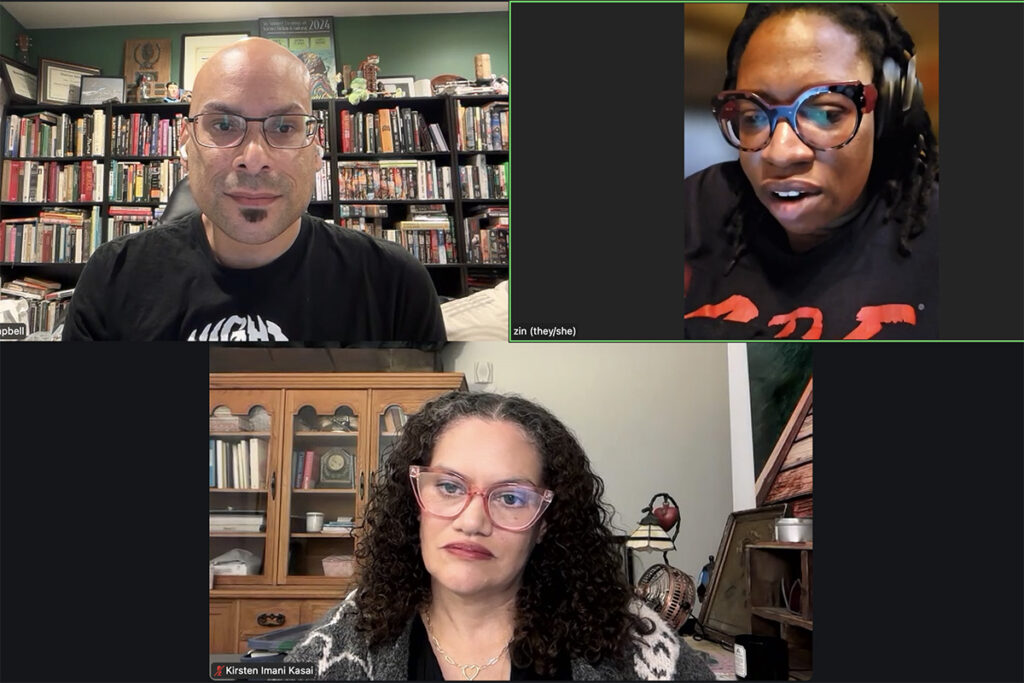
With Writing, Literature & Publishing Assistant Professor Kirsten Imani Kasai, panelist and WOC member Chris Campbell ’26, Rocklyn discussed their writing process, and the growing influence of the panel’s theme: The Monstrous Feminine. This concept, popularized by Barbara Creed’s 1993 book, The Monstrous Feminine—Film, Feminism, Psychoanalysis, studies how femininity has been portrayed as a source of terror in horror media, and what this implies for society’s outlook on patriarchy and the female body.
Rocklyn read from their upcoming second novella: a piece they have been working on for more than a decade that delves into the horror genre and psychological terror with a character empowered by mysterious, supernatural forces.
Imani asked the author how their experience as an outsider on many different fronts informs their writing.
“Being an outsider enriches the characters you come up with, and the experiences they face,” Rocklyn said. “If I were an insider, I feel as though my stories would be more common, more of ‘the same old’ stories.”
The discussion shifted towards a reflection on body-horror and the role that “the grotesque” plays in Rocklyn’s writing.
“The grotesque is something we need to face in order to figure it out,” said Rocklyn. “I love body horror. I love body sensations and facial expressions. [But] we tend to ignore ‘subtle’ feelings: we only focus on the extremes. Extreme pain, extreme pleasure. But subtle sensations help readers really enter a story and relate with the characters.”
An audience member asked Rocklyn whether pain belongs in writing, and if so, how it should materialize on the page.
“Pain belongs in writing. It’s therapeutic. It allows for empathy. … Physical, psychological and emotional pain tells you different things about your character. Pain is important to create empathy, to create a sense of place and time. Does that pain endure? What alleviates it?” said Rocklyn.
Campbell asked for Rocklyn’s thoughts on the panel’s theme, and whether it’s something they contend with within their writing.
“I think it’s an idea that will persist for a long time. The reality is most women are bleeding three to five times a month, and there’s a lot of downplaying that. There’s a lot of downplaying pregnancy. There’s a lot that’s still mysterious about women, and this mystery becomes a source of horror,” said Rocklyn.
Categories
