
In Ireland, VMA’s Vaughan Examines Digital and Renewable Infrastructure Expansion
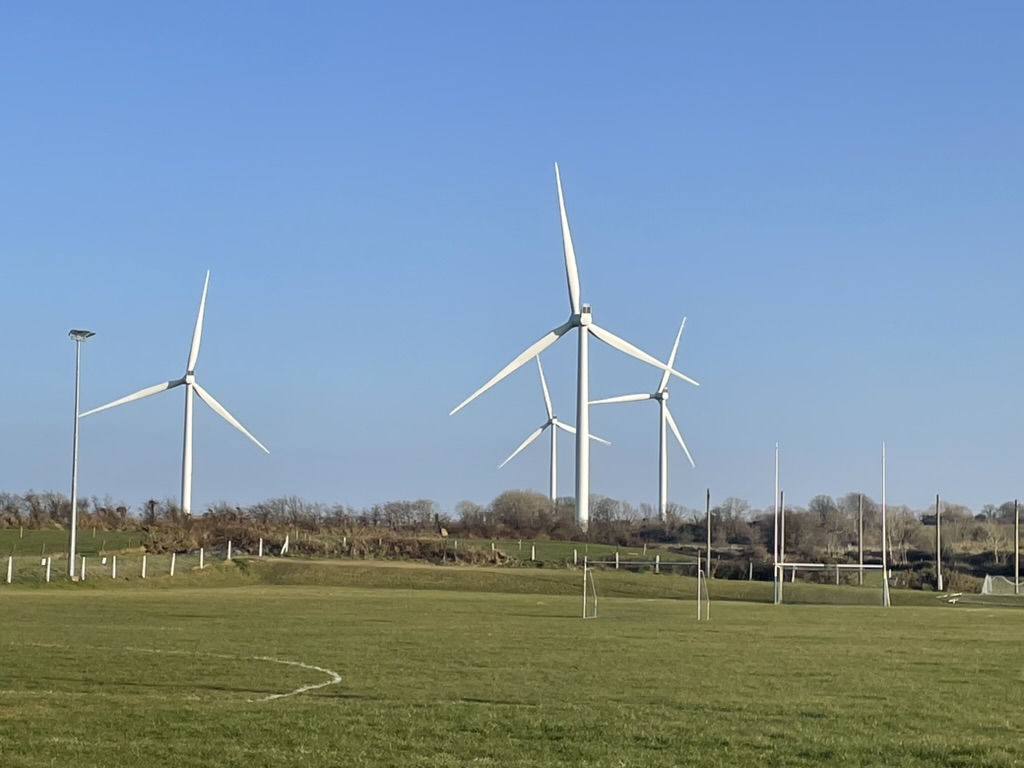
During the last 10 years, Ireland’s County Mayo has experienced a massive surge in digital and energy infrastructure largely financed by foreign big tech investment.
These structures aren’t being constructed for the benefit of local communities, but it’s the local communities who are feeling their effects.
“There are environmental impacts from taking up space and resources, and prolonged use of energy and water,” said Visual and Media Arts Assistant Professor Hunter Vaughan.
As a co-Principal Investigator of the Sustainable Subsea Networks project, Vaughan is researching the issue with University of California Berkeley professor Nicole Starosielski with a grant from the Internet Society Foundation. His research in particular is looking for ways to empower communities in Ireland to advocate for themselves with regards to big tech, energy projects, and environmental impact.
They started the project in 2022, thanks to a $200,000 ISF grant as part of a project led by Starosielski, and including other collaborators. In 2023, ISF came through with another $500,000.
The cable landing stations being built are affecting Ireland’s coastal ecosystems, Vaughan said. Data centers are often built on coasts to be co-located with cable landing stations. And in Ireland, colder oceans provide readily available and cost-effective cooling solutions.

County Mayo’s beautiful landscape also is being altered by wind turbines, while the ocean floor is being littered and snaked with fiberoptic underwater cables that circulate 95 percent or more of international data.
Vaughan said that Ireland is not alone in having its terrestrial landscape and ocean floor being altered by big tech companies, but it is a bellwether of a growing problem.
“Ireland has proven in the last 10 years as the perfect example of the canary in the coal mine as to what happens when tax incentives and intervention of foreign investment lead to growing disparities and inequities around resource use and localized political agency,” said Vaughan. “Ireland is a very glaring example of this tipping point problem.”
Vaughan relished the opportunity to utilize what he learned from his initial research in 2022-2023, and apply it to his current study. This summer he and environmental scientist Dr. Meryl Shriver-Rice went to the village of Killala to conduct two weeks of community research, with two days of organized in-person community events, developed in partnership with local facilitator Annette Maughan .
“We wanted to include more community-based research in this second round of research that’s more focused on social sciences and interdisciplinary approaches,” said Vaughan. “We wanted to focus … scenery over systems – but not just landscape, we wanted it to be a social thing.”
The desire to be more community-focused contrasts the first round of research. At the time, he tried to blend academic scholarship with community engagement and collaboration with digital infrastructure industry stakeholders, to push for positive change and industry growth.

Their work included a multi-authored 70-page report, white papers, and other academic methods.
“I was hoping to provide options [that companies] could do that were both more sustainable and environmental that included renewable energy growth, as well as be socially-responsible by building out a renewable energy plan,” said Vaughan. “I wanted to connect [companies] to the local community to get a sense of how the energy infrastructures would affect the landscape.”
However, the research didn’t return the desired results.
For this grant phase, Vaughan and Starosielski and their team have worked to get big tech and energy companies more involved with establishing sustainable metrics for themselves and focusing on impacts of marine operations, cable landing stations, and cable recycling.
“The idea now is to get them involved and set metrics for themselves they can live up to and guide them in the future and then we can step away and let them lead their own way,” said Vaughan.
He wanted to go back to a rural setting and work with a local person to establish stronger community connections and participation. Having greater local involvement better allows the research team to make more visible for government and industry what it is communities want, which could make it harder to ignore.
“Specifically, we wanted to … try to understand how to better their relationship to the energy infrastructures in keeping with their longstanding sense of landscape heritage,” said Vaughan.
His hope is that community members provide feedback on where things like wind turbines should be placed along the landscape, or if different methods of energy infrastructures can be used.
“We want to make this more public to amplify their voices and catch the ear of politicians who are policymakers, and do it in less academic settings,” said Vaughan. “We might do a newspaper story, interview for radio, a podcast or two.”
Vaughan is not naïve that any deliverables for energy industries are predicated on profit. But he’s very focused on any benefits that can be provided to the community if big tech and energy growth is inevitable.
“I really hope this helps or lends itself to more conversation about localized community impacts of this type of infrastructure growth,” said Vaughan. “Most communities don’t get their voices heard while their landscapes are converted into infrastructure space for data.”
Communities in the United States are also increasingly struggling with environmental impacts and intense energy usage as tech regulations are lowered or relaxed in order to accommodate the data demands of high-computational machine learning (or so-called ‘AI’) systems such as ChatGPT, said Vaughan.
After just a year at Emerson, Vaughan is eager to build out environmental media research on a local level, and believes that this summer’s work provides a model he can implement in Greater Boston and the Northeast region.
Categories
