Building Your Own Major: Munsat ’27 Focuses on Accessibility Through Media and Deaf Studies
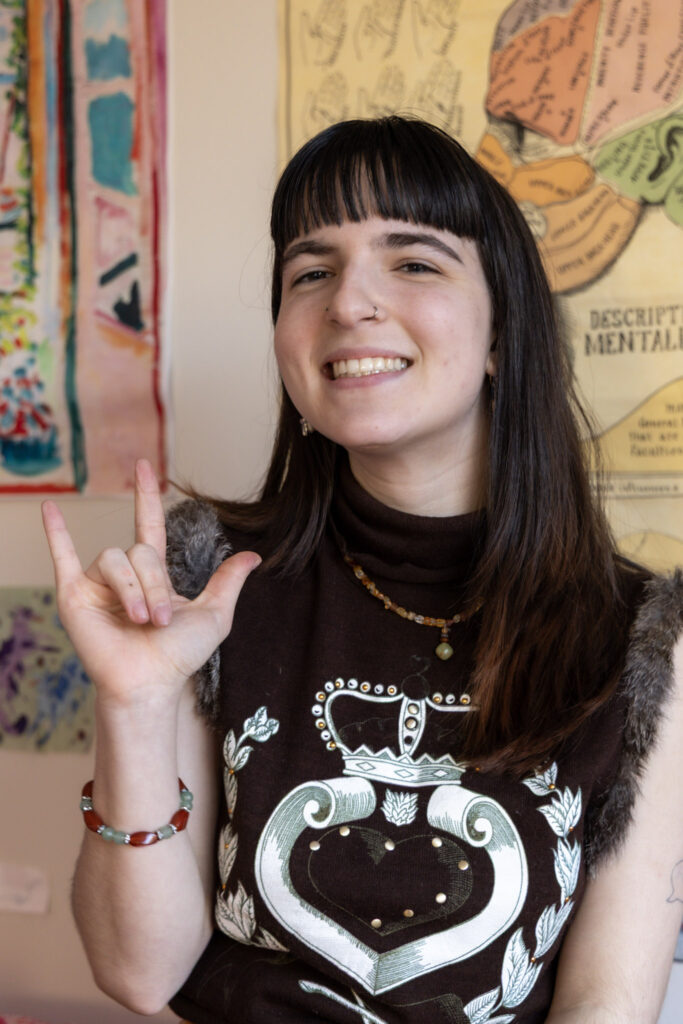
Hallie Munsat ’27 wants to make film festival programming more accessible.
So she created her own major as a step toward achieving that career goal, combining media studies with deaf studies.
Why did you choose Media and Deaf Studies?
Munsat: The disciplines that I am combining are the School of Film, Television & Media Arts and the Hearing and Deafness minor. In order to combine those, I found an intersection between them, and now I’m focusing on media accessibility.
Why did you pursue an Interdisciplinary Studies (IDS) major?
Munsat:I came into Emerson originally as a Visual & Media Arts major, and a Hearing and Deafness minor. As I was going into my freshman year, I realized that I wasn’t going to do enough of the Hearing and Deafness side of it. I heard about the IDS program through my roommate, who was an IDS major. I switched at the end of freshman year and started the program my sophomore year.
What was the process like to create your own IDS major?
Munsat: There are actually a few precedents to my major. Breazy Graves, MFA ’25, was another student who combined the same areas of study, and she graduated last year. She’s been a really big help in understanding my major. Coming up with my major was interesting because I originally didn’t come into Emerson wanting to study media accessibility, but inherently, when you’re combining film and deaf studies, the intersection you’re going to see is representation and accessibility.
How do you plan on using your major in your career after graduation?
Munsat: I’m really interested in festival programming. I had an internship over the summer where I was an accessibility coordinator talking about film festival accessibility issues. It’s a big issue and there is a really wonderful nonprofit organization in LA called FWD-Doc that is trying to uplift disabled documentary filmmakers specifically. People with disabilities are the largest minority globally, and if people are having issues accessing film in a communal way, that’s something worth looking at because that’s just leaving out a whole portion of people that cannot interact with one of the things that make us human and one of the things that we use to communicate with each other. So accessibility coordination is definitely a job I see myself in.
How has Emerson provided support for you, whether that’s academically, personally, or professionally?
Munsat: IDS allowed me to do exactly what I wanted to do at Emerson. There are prerequisites that I can get waivers for that don’t pertain to my major, which has been super helpful. I love the community that it’s brought me. I know so many people in it, and [Associate Professor and Director of Interdisciplinary Studies major] Jamie [Tanner] is a saint. She really cares about the students, as do all of the Marlboro Institute professors, and the students care about each other too. Because we’re all doing pretty different things from each other, we consult each other a lot. Sometimes when we’re talking about a major, we’re saying “Hey, do you know this person?” or “Do you know this article?” or “This might be of interest to you.” It’s really community-based.
What extracurricular activities have you participated in?
Munsat: I’m part of the debate team, which has been also one of the reasons Emerson has been amazing. [Communication Studies Associate Professor and Debate Team Director] Deion Hawkins is the best mentor that I’ve had at Emerson. I also am vice president of the ASL Club. I can use what I learn in ASL Club when going out into the deaf community in the greater Boston area. I’ve used a lot of that to inform my studies and what people in the deaf community are looking for in terms of accessibility. I’m also on the IDS Planning Committee. That’s gotten me a lot more immersed in IDS.
What classes are required for your major? What have been some of your favorite classes?
Munsat: My ASL classes have been really helpful. I’m in ASL IV right now, and three out of four of my classes have been with [Communication Sciences & Disorders Affiliated Faculty] Scott Shupert, which has been really fun. My film producing class has been really helpful in trying to appeal to an audience and also understand the pre-production element of filmmaking. There aren’t that many classes that directly feed into both disciplines, so what I’ve been doing is just taking a lot of what I’ve learned from my film production classes and applying that to what people might want to see at festivals. I have [School of Film, Television, and Media Arts Assistant Professor] Amy Beecher right now for my MI390 seminar, and she’s been really helpful. She’s been giving me a lot of recommendations to people I can reach out to for my capstone. I don’t have that many classes that feed into each other, so my biggest resource is my network.
Every IDS major must have a capstone project. What is your capstone project?
Munsat: I’m super excited about my capstone. I just got funding for it last semester, which is great because it’s going to require a lot of money for licensing purposes. My hope is to conduct an accessible film series, open to the public, regarding deaf representation, and deaf and hard of hearing stories. I want the film series to be about deaf and hard of hearing stories. I have a lot of ideas for what that may be. For the analytical component, I’m doing a research paper on the importance of captioning sound effects in movies.
Any final thoughts?
Munsat: I’m so happy to talk about IDS! IDS involves so much critical thinking. IDS absolutely gave me what I needed. It has been such a great community, and it’s a lot of work, but it has been great.
Categories
