
Master Class: In Conversation with Filmmaker Chloé Zhao
Chloé Zhao, the second woman ever to win the Academy Award for Best Director and the first woman of color to receive the honor, gave a Master Class on March 5 at Emerson Los Angeles. The Oscar-winning filmmaker spoke about her start in the industry, filmmaking style, and directing the acclaimed films Nomadland and Hamnet.
Emerson College Master Classes is a dynamic initiative directly supporting the Extraordinary Emerson 2030 strategic plan. The program connects students with accomplished professionals and industry leaders in the arts and communication, providing the real-world expertise essential for career readiness. Master Classes are held in Boston and Los Angeles exclusively for the Emerson community.
In a conversation moderated by Special Projects & Programs Specialist Glenn Meehan ’83, Zhao began by reflecting on how she became a filmmaker. She moved to Los Angeles at 19, lived in an apartment in Koreatown, and barely spoke English. Filmmaking seemed like an impossibility.
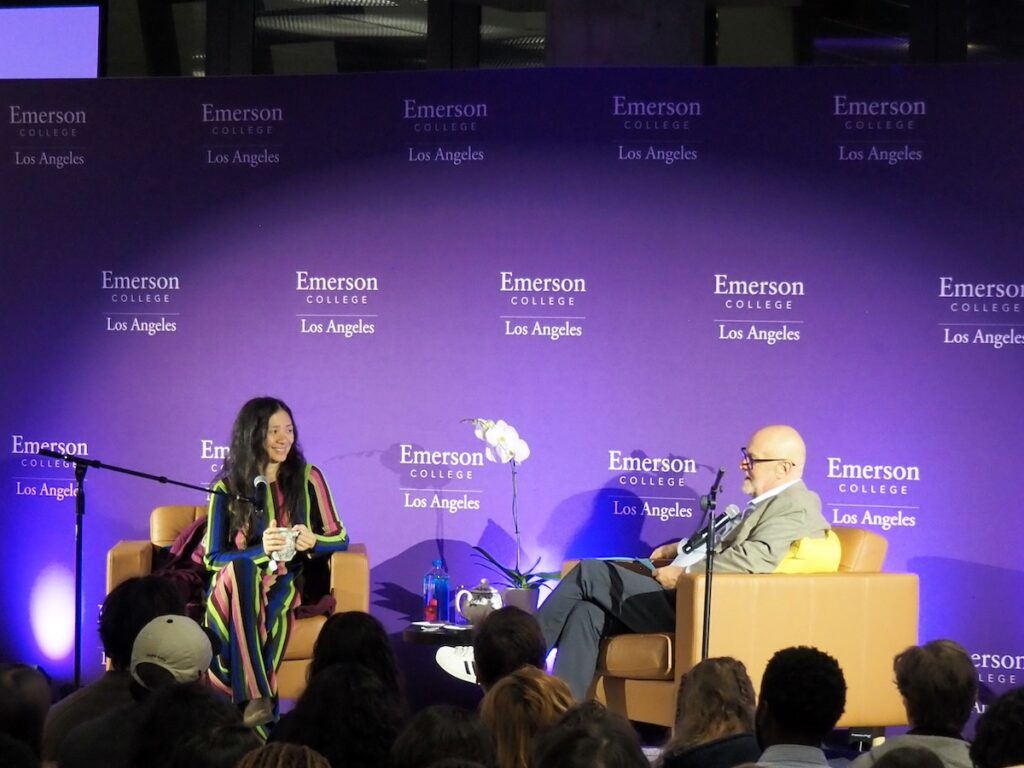
“Imagination is something that helped me through my childhood and teen years. I thought just being near [Hollywood] would be special, but I definitely didn’t come here to pursue a dream,” said Zhao.
In college, she majored in politics. After graduating, while bartending and working odd jobs, Zhao found herself drawn to people and their stories, ultimately leading her to study and pursue filmmaking.
Her debut film, Songs My Brothers Taught Me, a naturalistic drama exploring life on the Pine Ridge Reservation in South Dakota, came with many challenges. She didn’t have money. Footage was stolen from her apartment. The kids she wanted to cast were aging. With support from people who believed in her, Zhao kept moving forward.
“You have a choice in a moment like that. You can keep pushing… and wait because your vision is so important, or you can surrender and listen to what something bigger is trying to tell you,” said Zhao. “For those of you who have seen Hamnet, you see that once you surrender, then there’s a chance for a rebirth and a new life. That energy is gonna take you to who you’re meant to be, but if I had held out and waited and kept going, I wouldn’t be here today. The greatest challenge was also the biggest lesson.”
Many of Zhao’s films, like The Rider or Nomadland, feature non-professional actors, which helps give her work a documentary-style realism. She counts Terrence Malick and Werner Herzog among her influences, but says filming documentary-style isn’t an aesthetic choice. It’s fueled by a desire to capture truth in the present moment. Zhao says the key to working with non-professional actors is getting to know them: watching, listening, and understanding who they are.
“Find little moments that they are giving you just by having a meal together that you know you can use in your film. Let what they can do on the day be the driving force for the plot. Don’t ever go to set and say they have to hit this emotional beat for the plot to move forward,” said Zhao. “What they’re gonna give you that professional actors will have to work so hard to get there… is presence and authenticity. That presence, when it’s serving the scene that you write, it looks like you’ve done incredible directing to get this performance out of this person, but it’s in the writing.”
This year, Zhao is nominated for two Oscars for Hamnet: Best Director and Best Adapted Screenplay. The film, a fictionalized story of how William Shakespeare and his wife, Agnes Hathaway, cope with the loss of their son, is nominated for eight Academy Awards.
She spoke about directing Jessie Buckley through a particularly difficult scene in the film, when her son dies. Zhao said she had developed an unspoken trust with her actors and created a safe container for them to express themselves.
“She wasn’t alone doing that scene. By then, my 200 crew members, when they come [to set] they know exactly what we’re filming that day. Every one of them, at that point, knows it’s safe enough to come to the village with their own broken heart. You can hear a pin drop in the morning,” said Zhao, who mentioned Buckley chose songs to have playing on repeat to help in her process. “It really feels like a ceremony that you’re preparing her for and she is in the center.”
Each Friday on set, Zhao said she would lead everyone in a choreographed dance take. Because some scenes were so difficult emotionally, she wanted to lead her actors out of the container they’d gotten in together. Actor Jacobi Jupe, who plays Hamnet in the film, even came up to her on the day that his character was going to die and asked to have an extra dance take with the song “Stayin’ Alive” by the Bee Gees.
“It seems like a waste of time because you’re not producing, except for your DVD specials, but what that does, the message that you’re sending out to everyone on that set is that they matter. That everybody matters. That we’re in it together. When people are trusting you that way, they’ll do anything for you and for the film and then you’re really unstoppable,” said Zhao.
Now, after spending the last several years directing films back to back, Zhao is ready to recharge.
“I was still pushing after Eternals and that’s four films without a break,” she said. “Nothing was working because I was trying to plant a seed on really, really barren and malnourished soil. I crashed. This was a big one, two years. I think I’m gonna take six months and just chill.”
Amanda Jacobson ’26, a Performing Arts major, said learning about Zhao’s process for directing actors resonated with her.
“I was most compelled by how she spoke about her process with actors on set and curating this space for the art to thrive, even though it is considered costly,” said Jacobson. “Presence can often be the hardest thing for actors to curate on set since they’re usually expected to jump right in, so a director of her caliber centering process, especially for actors, is really incredible.”
Closing out the evening, Zhao was asked for the best piece of advice she’s ever received.
“Take five. Don’t bang your head on the door, on the wall, and just keep going,” said Zhao. “Make sure you have people around you who can pull you back and go take a nap. Even when you’re writing, just go for a walk.”
For Chrystee Pharris ’98, who has spent much of the past year hustling and working as an actor, Zhao’s advice about slowing down struck a chord.
“She said so much that inspired me as an actor, director, and a person, like taking time for myself and listening. I took notes and I can’t wait to go back and watch it,” said Chrystee Pharris ’98. “I need to take that break.”
“Getting to be at an event with Chloe Zhao while I’m prepping my own feature and [being] inspired by her journey, it brings together so many different worlds for me,” added Jason Pearlman ’07, a writer, director, and producer. “It’s such an amazing opportunity to be surrounded by generations of Emersonians and hear from her.”
Categories
