
From Sketchbook to Screen: Greene ’26 Brings Character to Life
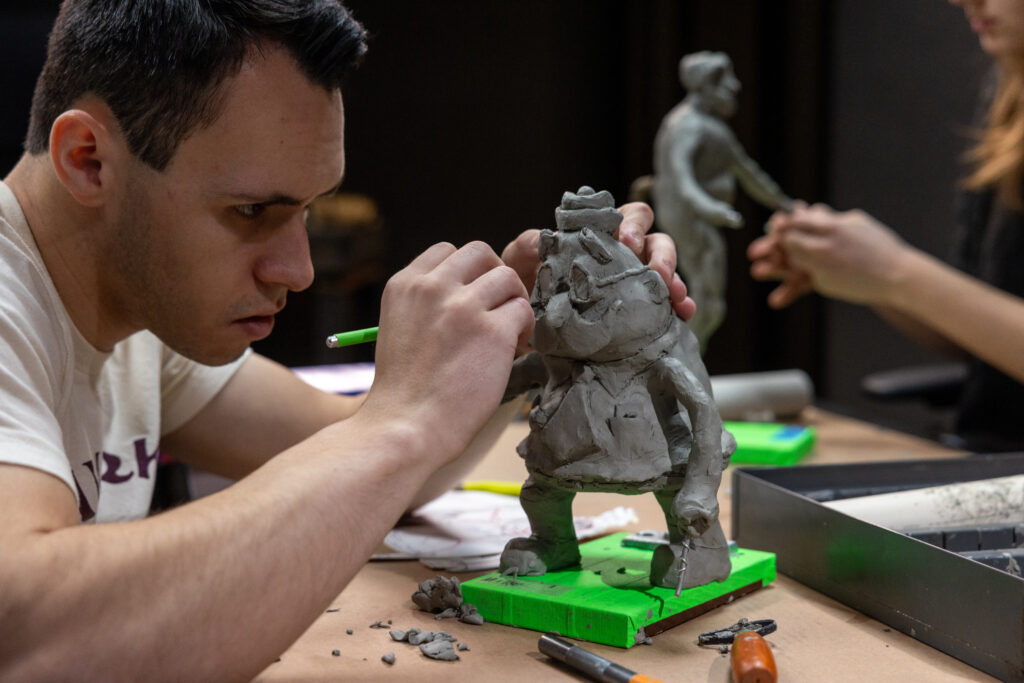
In a display case on the third floor of the Ansin Building stands Wadsworth, a clay character created by Michael Greene ’26. The sculpture is just one piece in a larger process that started on paper and culminated in a short multimedia film combining live action and animation, showcasing the range of skills Greene learned at Emerson, brought together in a standout demo reel.
Greene, a Media Arts Production major who transferred to Emerson in January 2024, first created Wadsworth in spring 2025 as part of a character design project for his Sculpting and Animation class, taught by School of Film, Television and Media Arts Associate Professor Anya Belkina. Greene first sketched Wadsworth on paper before sculpting a 3D clay model.
Then, this past fall, Greene inserted Wadsworth into a four-minute final project for Advanced New Media Projects with SOF Professor John Craig Freeman in which he created Wadsworth as a 3D animated character and blended in live action, 2D animation, and computer-generated imagery.
“I’m really interested in animation and character development,” said Greene, who is spending this semester at Emerson Los Angeles.. “Creating this project was a really fun process. I really like the character — it’s something new I hadn’t done before — and it fits well with continuing what I started.”
He credits Emerson — and professors like Belkina and Freeman — with pushing him to bring his ideas fully to life. “They really support your creative vision,” Greene said. “It’s always about, ‘How can we take your idea and make it happen?’ Emerson has the resources and the people to do that.”
Designing Wadsworth
The original assignment challenged Greene to design a character from scratch. Wadsworth was modeled after people Greene has encountered in his own life, particularly a waiter whose calm and welcoming presence left a lasting impression.
“He was always this nice, calm, happy person even when it seemed stressful,” Greene said. “I loved that personality. I wanted to make someone inspired by that.”
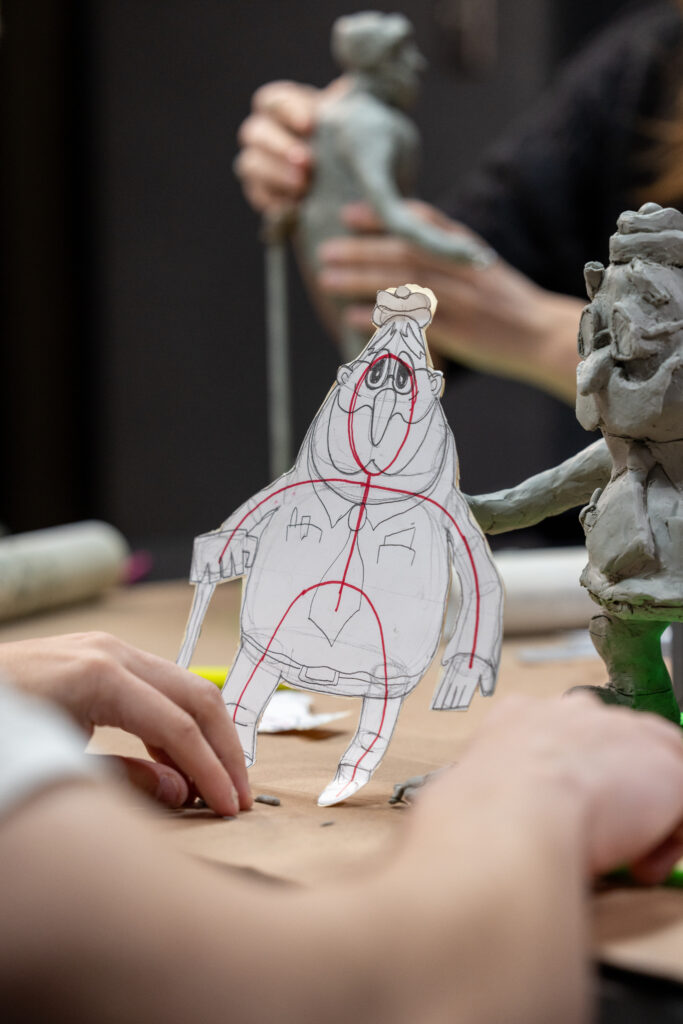
So Greene started creating Wadsworth, an older bartender. Greene began with dozens of sketches, experimenting with shape language and silhouette. After multiple revisions—and significant feedback from Belkina—he landed on what he describes as a triangular, pear-shaped design. Belkina stressed one of the most difficult parts to understand—the importance of character appeal. One transformative suggestion was to give Wadsworth a slight hunch.
“That really changed a lot about how I designed the character,” Greene said. “It looked smoother, and it fit his personality. It showed how you can express personality through design.”
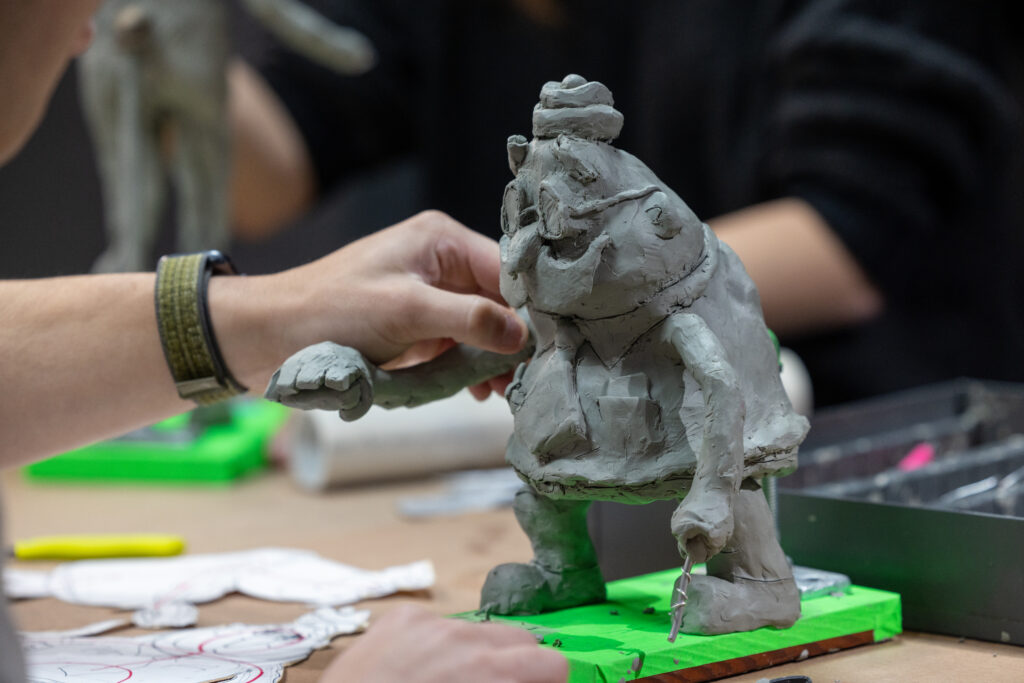
The process moved from pencil sketches to digital coloring and inking before shifting into sculpture. Using thick wire as an internal skeleton, aluminum foil to build mass, and clay to shape the exterior, Greene constructed Wadsworth by hand during the course of two weeks. After refining the basic forms, he added details such as the eyes, nose, and mouth.
The next challenge was scanning the sculpture into 3D software and rebuilding it as a digital model to be rigged for animation.
“It’s a long, detailed process with a lot of steps,” Greene said. “It’s very new for me — and very frustrating sometimes — because things don’t always work the way you want.”
One lesson learned? Always prepare for the next stage.
“When I scanned the character, I didn’t put him in a T-pose,” Greene explained, referring to the standard arm-outstretched position that makes digital rigging easier. “That’s something I’d definitely do differently next time.”
Blending Media, Building Worlds
Wadsworth also appears in Greene’s short film, Charlie the Duck and the Search for Happiness, a four-minute video that serves as a fantastic demo reel that Greene completed in December.
The film follows Charlie, a whimsical, energetic duck Greene first created in 10th grade and later wrote about for a college essay. In the story, Charlie embarks on a journey to find happiness, only to discover it in an unexpected place. Wadsworth serves as a calming confidant who gently reminds Charlie what happiness truly means.
While Wadsworth was animated in 3D, the other characters were hand-drawn in 2D and composited into live-action backgrounds — a stylistic blend Greene likens to Who Framed Roger Rabbit. Part of Greene’s production was securing permits to film in locations such as the Boston Public Garden and experimenting with visual effects that allow animated characters to interact with real-world objects.
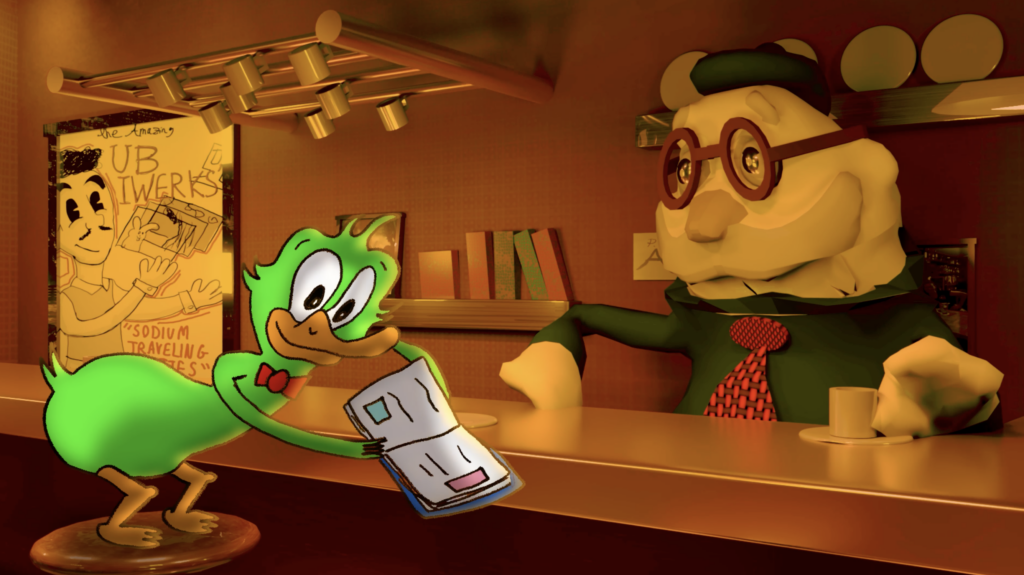
Wadsworth’s digital rig, Greene explained, functions almost like a puppet — a nod to stop-motion principles executed in a 3D environment.
“I love combining different forms of media,” Greene said. “How can you take a story, take a character, and combine technology in a way that feels new and interesting? That creative process is the most exciting thing to me.”
Greene, who will graduate in May, says working on various film sets and collaborative projects has significantly shaped him as both an artist and filmmaker.
As for what comes next, he remains open.
“Ultimately, I’d love to work in film or animation in some capacity,” he said. “I’m really interested in the creative development process — thinking about how to build characters and worlds.”
Categories
