
Neverett ’88 Shares the Playbook for Sports Broadcasting
As an announcer for the World Champion Los Angeles Dodgers, it’s Tim Neverett’s job to share compelling stories and other nuggets of information with fans to keep them interested and invested in the sport of baseball.
And he’s spent years perfecting the art of storytelling from the announcer’s booth: in Pittsburgh (for the Pirates) and in Boston (for the Red Sox), as well as covering basketball, football, and the Olympic Games.
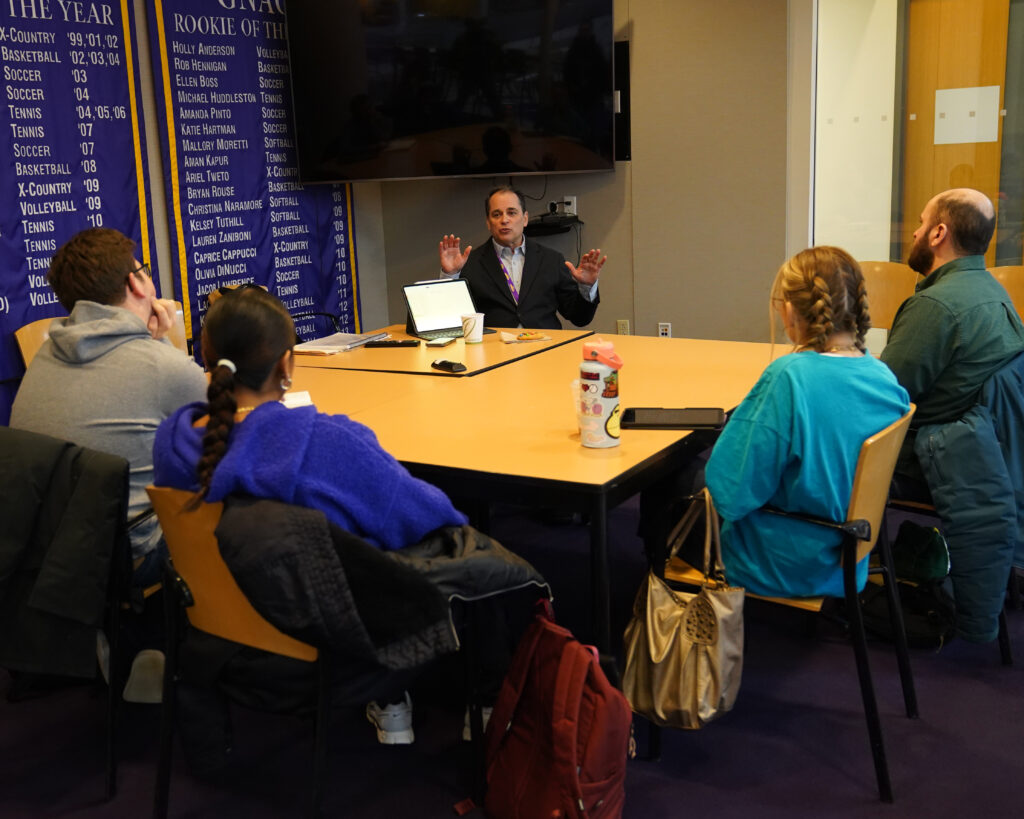
Neverett ’88 returned to Emerson last week to share the knowledge he’s gleaned throughout the course of his career. He met with students in Boston, giving them an immersive look at the role that broadcasters play in bringing games to life for fans—whether on television or through the rhythm of play-by-play on the radio.
“When I return to the Boston campus, it always feels like I’m coming home,” said Neverett, who is based in Los Angeles and serves as a Communication Studies affiliated faculty member at his alma mater. “I love seeing familiar faces, and I am always welcomed with open arms.”
During his visit last week, he gave a two-hour workshop in the Skybox at the Bobbi Brown and Steve Plofker Gym, offering students a comprehensive roadmap for preparing to call a game.
Five Takeaways from Neverett’s Advice for Aspiring Broadcasters
- Get as Familiar as You Can
Preparation is the foundation of successful broadcasting. Neverett detailed the extensive research he conducts before each game– a process that can take up to a month– to ensure he can respond to every noteworthy moment with speed and confidence. From developing storylines to compiling key statistics, his goal is to be ready with context that informs and engages listeners.
“Failing to prepare is preparing to fail,” he said.
- Find the Storylines
“You have to sell every game, because at the end of the day, you are selling the sport,” Neverett said.
Staying current on players’ performance and teams’ developments throughout the season, he explained, helps broadcasters craft compelling narratives. Those storylines give fans a reason to stay invested.
“Above all, play-by-play announcers are storytellers,” Neverett added.
- Go to Practice
“If a game starts at 6 p.m., you’re not there at 5 or 4, you’re there at 10 a.m.”
Attending practice sessions, Neverett said, allows broadcasters to gather context, observe team dynamics, and build anticipation for the upcoming game. That additional insight enhances the depth and authenticity of the broadcast.
- Talk to the Head Coaches
Building strong relationships with head coaches can provide valuable “scoops” that add color and detail to a broadcast. It’s the announcer’s job to weave those insights into the game’s larger narrative.
“We watch sports because sports are fun,” he said. “Announcing sports should be exciting.”
- Talk to the Players
The final step in preparing for a broadcast, Neverett said, is speaking directly with players. These conversations, like those with coaches, help announcers gather meaningful details that enrich play-by-play analysis.
Neverett also shared with students the organizational system he uses to quickly access player information and statistics during games, allowing students to review his comprehensive notes to better understand the depth of preparation required.
“You want to give fans the ‘nuggets’ they don’t know,” said Neverett.
Categories
