Multi-Year CSD Study Looks at Confidence in Communicating
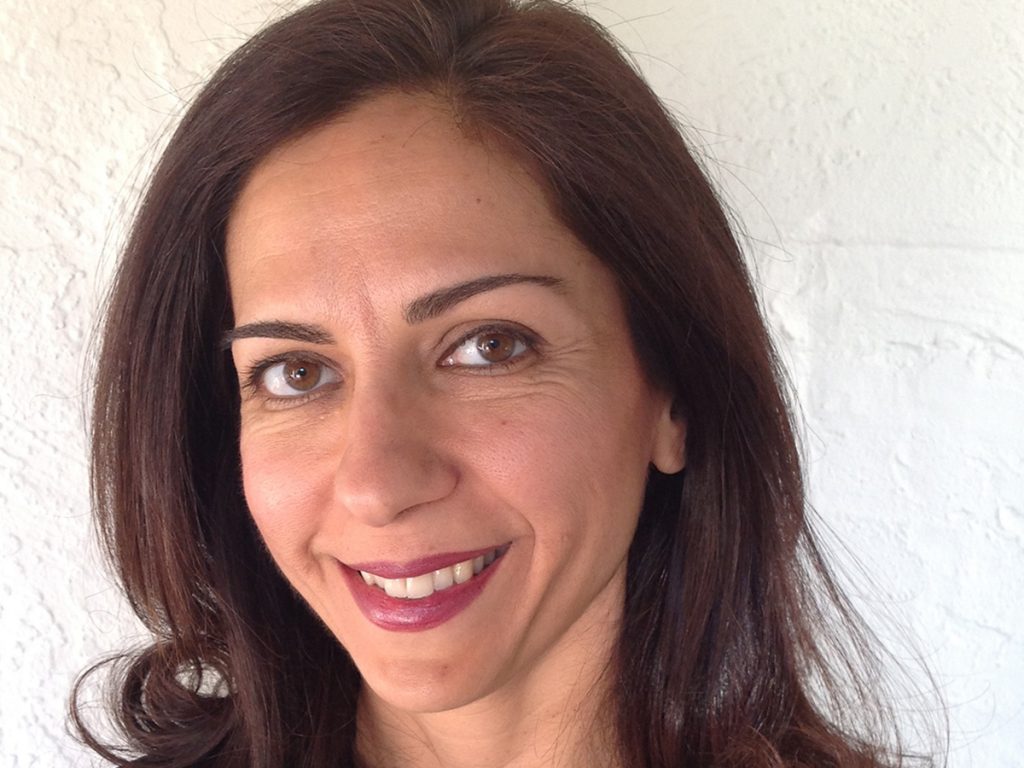
Maryam Salehomoum wants to know how d/Deaf and hard of hearing (DHH) college students feel about their communication skills and what factors influence that belief.
Salehomoum, a Senior Scholar-in-Residence in the Communication Sciences and Disorders Department, is working on a multi-year study looking at communication self-efficacy (CSE) of this population of students. And in doing her research, she’s helping some of Emerson’s own DHH students advocate for their needs and more confidently communicate.
“One thing that people with hearing loss mention repeatedly is, ‘If I can’t hear the speaker, it tends to diminish my confidence, and I withdraw,’” Salehomoum said.
Self-efficacy is how confident one is in being able to master a skill. It can apply to picking up a sport, learning a musical instrument, public speaking, or, in this case, communicating in a classroom setting. The term d/Deaf denotes the distinction between deafness as a medical condition (lowercase d) and membership in the Deaf culture and community.
The project arose through a collaboration between Marlboro Institute Professor Emerita Eileen McBride, a psychologist who was studying self-efficacy in parenting a child with autism, and Salehomoum, who was interested in DHH college students.
Specifically, Salehomoum wanted to know what factors contribute to the students’ self-efficacy or lack thereof, and whether DHH students report the same contributing factors that hearing people do. Salehomoum explained that a theoretical model of self-efficacy suggests there are four contributing sources of self-efficacy: mastery of a skill (opportunities to practice, and whether those opportunities are a success or failure); social persuasion (other people’s responses to you when you’re demonstrating a task); physiological/psychological status (how performing a task makes you feel); and vicarious learning (learning from other people doing the same task).
Salehomoum surveyed DHH students from colleges and universities around the country about how they perceive their communication self-efficacy, and received 62 responses. She then followed up with interviews when respondents were willing to give more in-depth data.
“Because they have hearing issues, they also started to talk about environmental factors: distance from the speaker, background noise, multiple speakers at the same time, which were sort of unique to deaf and hard of hearing students,” Salehomoum said.
This research project is still in its initial phase, but it’s already yielding results for some students with hearing loss at Emerson.
Salehomoum created an abridged survey to give to Emerson students. Unlike with the larger sample, she didn’t require Emerson participants to have a formal diagnosis; she just sought out students who felt they had differences in their hearing. As with the larger study, she’s interviewing Emerson students to get more in-depth answers about their hearing and communication needs and their ability to participate in class.
“Through those conversations, I get to learn more about their individual cases, and I’ve been recommending things that I think would be helpful to them,” Salehomoum said.
Sometimes it’s just a matter of increasing students’ awareness of what’s impacting them.
“[I’ve asked] ‘Do you experience listening fatigue?’” she said, referring to the cognitive and physical exhaustion that straining to hear can produce. “And they’re like, ‘Oh, well, sure, but I’ve never thought about it as an impact; I just really think, did I hear or did I not?’”
Based on what she’s learned, she’s created a flyer for Student Accessibility Services (SAS) to distribute with quick tips for ways students can improve self-efficacy in communication. These include practical accommodations, such as sitting closer to the front of the room or using a listening aid, as well as ways to self-advocate, such as disclosing hearing loss or asking instructors or classmates to speak up or speak more slowly.
Bella Nordman ’28 was one of the Emerson students who took Salehomoum’s survey and followed up with an interview. The Journalism major said for most of her life, she has dealt with hearing loss in one ear, but never did much about it. When she saw the call to fill out the survey, she felt like she had helpful information to share.
Nordman was asked questions about how comfortable she was with hearing in classroom settings, and how she felt communicating with people one-on-one, but it was during her interview with Salehomoum that she got some valuable feedback. Salehomoum suggested she get audio enhancers for her classes to help with the listening fatigue she feels at the end of the day.
Categories
