
Speech-Language Pathology Grad Student Uses Mindfulness Techniques in Clinical Training
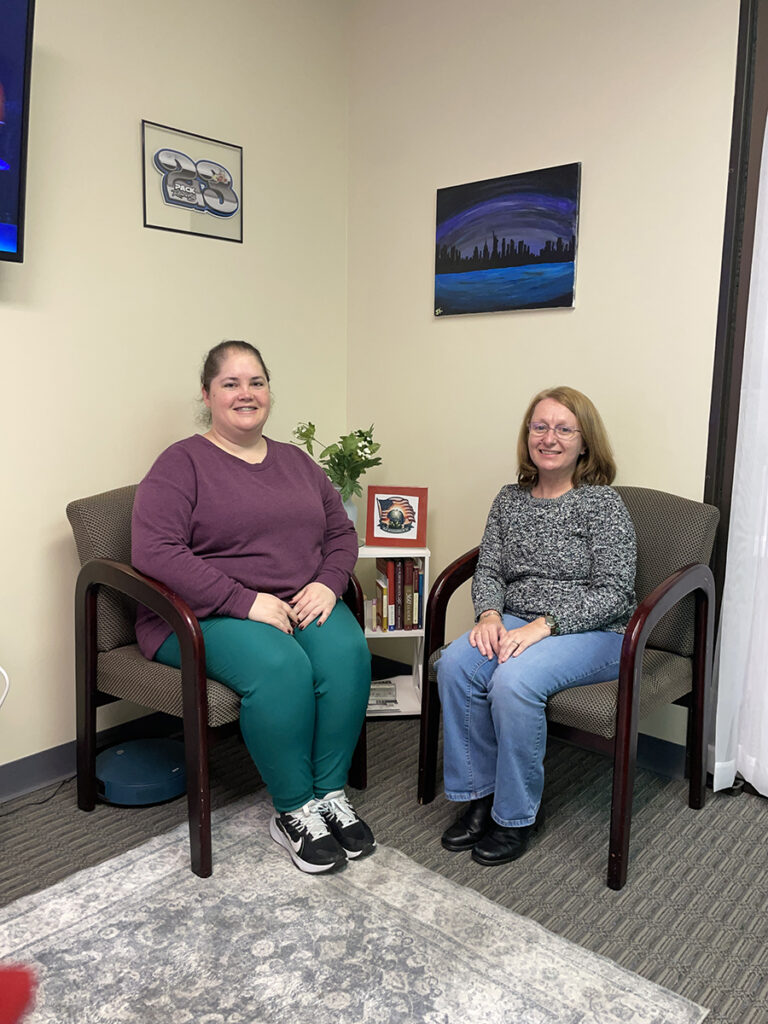
Nichole Proulx, MS ‘25 realized she wanted to become a speech-language pathologist (SLP) shortly after her son was born. An SLP was one of the first specialists to visit Proulx and her husband while their son, diagnosed with a rare syndrome causing facial and palate abnormalities, was in the neonatal intensive care unit.
“I had so many people pour into not just him, but into my whole family,” Proulx says. “That was when I started [thinking], ‘I want to do this for other families.’”
Over a decade later, having recently received her Master of Science in Communication Sciences and Disorders (CSD), Proulx has done just that, helping adults — many of them veterans — with mild traumatic brain injuries.
During her final clinical practicum at a private SLP practice in South Carolina, she applied many of the skills she learned through Emerson’s online CSD graduate program, commonly known as Speech@Emerson. Among the most effective, she and her clients discovered, are the mindfulness exercises that Proulx learned in a course titled Counseling in Speech-Language Pathology.
After creating a bank of breathing exercises and other mindfulness techniques for patients at her practice, Proulx and her supervisors observed significant shifts in her clients’ approach to their challenges. One man, with traumatic brain injury (TBI), had experienced anxiety so intense that he couldn’t manage a single word in a group session.
“We said, ‘Let’s take a break. Let’s do our mindfulness activity,’” Proulx explained. “He has one in particular that he really likes. We did it, and after that, he had a completely fluent speech for the whole rest of the session…it’s just really cool to see that.”
Joy Kinney, the owner of Speech-Language Pathology Associates of South Carolina, where Proulx conducted her practicum, said she has witnessed this patient’s transition firsthand.
“That session, and every session, is a motivator for this person,” Kinney said. “We have an unspoken rule that says, ‘If you can do it once, you can do it again.’ He is learning through mindfulness, that if he has a tool he can use to help himself, and it is successful once, then it will be successful again.”
In late November, just weeks before the end of her placement, Proulx was asked to give a presentation on these mindfulness techniques that have become a crucial part of the practice’s approach.
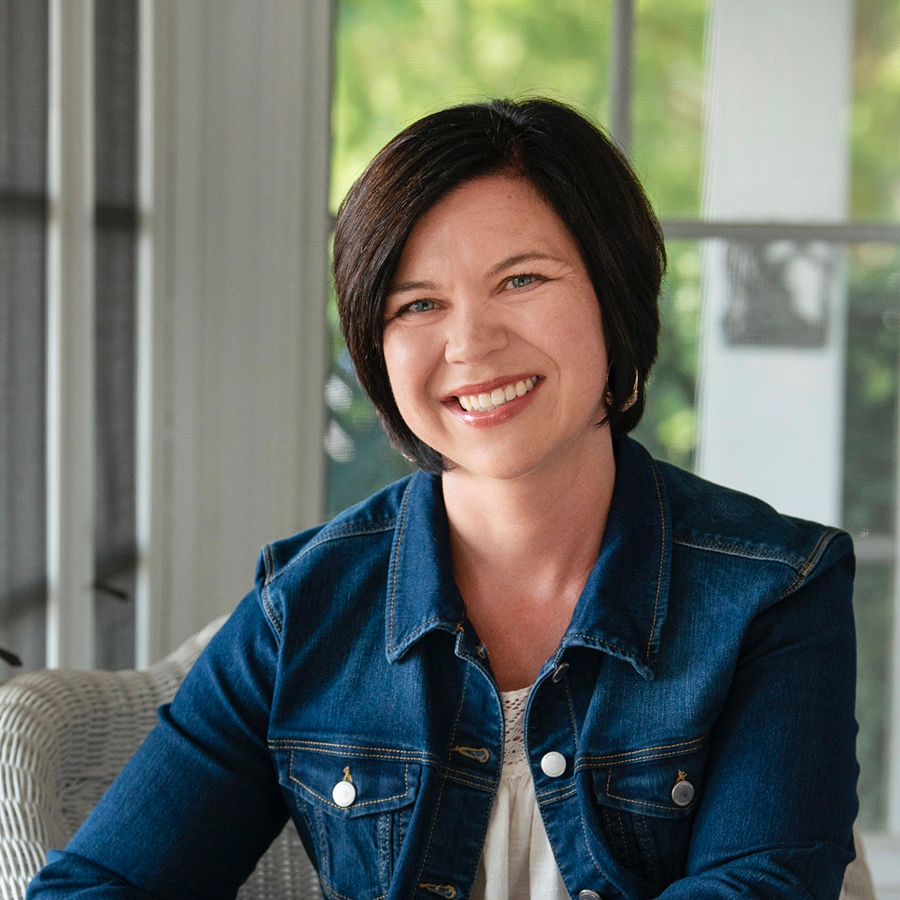
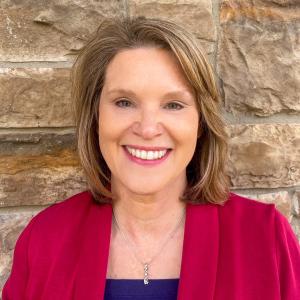
The creators of the Counseling in Speech-Language Pathology course, clinical instructor Barb Worth and Associate Professor Lisa Wisman Weil, teach graduate students like Proulx to practice deep listening and embody authenticity when interacting with patients.
“Counseling is something that we as speech-language pathologists do across all the different areas of our profession,” Worth said. “We are involved in counseling our clients and their family members. A lot of times we’re called upon to be with them at times of great stress or grief, when they are processing the impact a communication disorder can have on their lives”
Worth and Wisman Weil drew inspiration from the work and philosophies of Professor Emeritus David Luterman, who is widely admired for his contributions to the quality and culture of Emerson’s CSD program.
Instead of recording their lectures—as is common and often necessary for an online graduate program— Worth and Wisman Weil shared counseling methods with students in the style of “fireside chats.” The course involves experiential learning, where students engage in support groups and practice their counseling skills with one another. This helps to prepare them for when they will need to use those skills with their speech-language pathology clients and family members.
Counseling in Speech- Language Pathology is now a required course for all CSD graduate students.
“Deep listening and getting comfortable with silence are two of the most important skills we aim to teach our students in the counseling course,” Wisman Weil said. “Our students learn and practice these foundational skills, then layer on other supportive counseling skills.”
For Proulx, the program’s curriculum, clinical preparation, and approach to learning reaffirmed her decision to enroll at Emerson. With its flexible structure, she was able to study and gain clinical experience while supporting her husband’s military career.
“Everyone has been very supportive,” Proulx said. “These degrees aren’t meant to be easy, and they’re not easy, but Emerson definitely does their due diligence, making us feel supported.”
Faculty members like Worth and Wisman Weil take pride in knowing their instruction helps students become more effective practitioners.
“Graduate school can be extraordinarily stressful,” Worth said. “What we’re hoping is that some of these students will employ these mindfulness strategies in their daily life, which will, in turn, also help them to be effective speech-language pathology clinicians. Because if you come into a space where you can be in the moment…it’s really then that you can be fully present and be effective in your job. We also encourage our students, when appropriate, to use these techniques with their speech and language therapy clients.”
With her new Emerson MS in Communication Disorders in hand, Proulx and her family have settled in Murfreesboro, Tennessee, outside Nashville. She will spend her Clinical Fellowship Year at Magnolia Speech Therapy, a small pediatric practice that she says prioritizes a client-centered approach to therapy. While she hasn’t begun working with clients yet, Proulx said she plans to continue to use mindfulness in her future sessions.
“Mindfulness practices are a great way to build routine, foster connection, and enhance communication,” Proulx said. “I want to create a safe space where my clients can feel supported, seen, and heard. I want to meet them where they are, in the moment of life they are in, and I think mindfulness practices align with that incredibly well.”
Categories

Isabella Luzarraga View All
Isa is a senior journalism major minoring in media studies. She is from Omaha, Nebraska but loves coming back to the city. Outside of coursework, Isa is the Managing Editor of Your Magazine, the secretary of Emerson's chapter of NAHJ and a freelance writer for publications nationwide. She loves reading in the Common, going for long runs and sipping iced coffee.